Vibrational Profile
The seven energy centres as a symbolic map — what each one governs, what it sounds like, and where the tradition puts it on Earth
A is one of seven centres the Indian tradition places up the spine, from the base to the crown. Each is a theme rather than an organ — safety, appetite, will, connection, voice, sight, belonging — and each comes with a syllable to chant, a colour, and, in this corpus, a place on the planet. Pick one from the list and the card explains every line it prints.
What this is, and what it is not
This is a symbolic map, in the way a tarot spread is a symbolic map. The seven centres are a description of themes — safety, appetite, will, connection, voice, sight, belonging — laid out along the body because that is where people have always felt them, not because an organ was measured.
The 'stress pattern' line on each centre is the traditional association, not a diagnosis and not a mechanism. Nothing here says a chakra causes an illness, and nothing here should delay a doctor. If something in your body is wrong, that is a matter for medicine, and this page has no opinion about it.
What the map is genuinely good for: naming a state you are already in. Reading 'voice — and the specific damage of not saying it' and recognising your own week is the entire use of it.
A reference map of the seven centres, not a test — it asks you nothing and computes nothing about you. It sets out what each centre is traditionally held to govern in the body, the feeling, the mental pattern and the strain, together with the sound and the earth-site the corpus pairs it with.
What it computes
- 01The seven centres run bottom to top: root, sacral, solar plexus, heart, throat, brow, crown. That order is the whole spine of the system and every column below follows it.
- 02Each centre carries a seed sound — LAM, VAM, RAM, YAM, HAM, OM, AUM — the single syllable Indian practice assigns to it.
- 03Each carries a colour, running red at the base to violet at the crown: the visible spectrum laid along the body.
- 04Each carries a body region, a direction, an emotion, a psychology and a stress pattern, from the traditional associations.
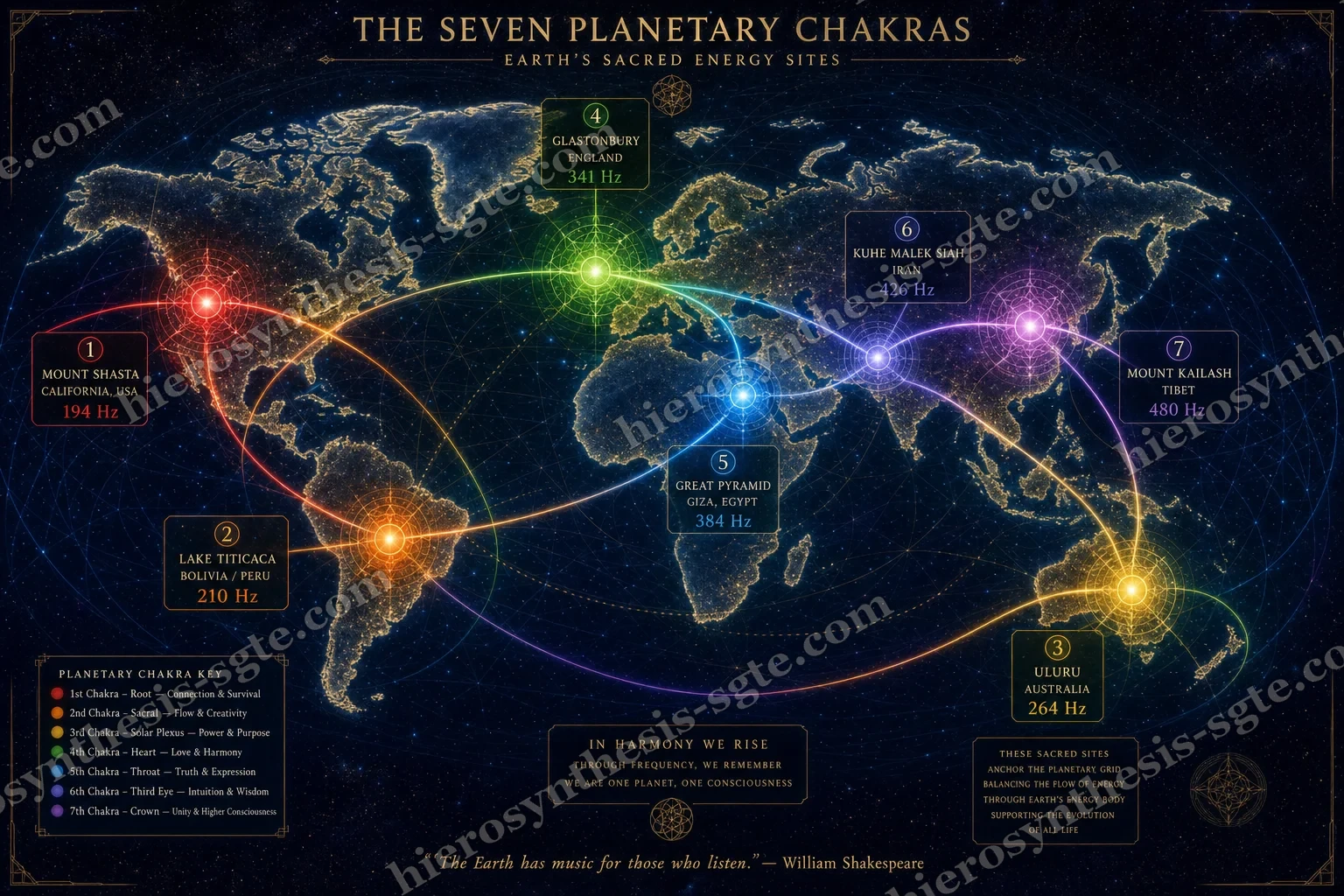
- 05And each carries a place on Earth, from the earth-grid tradition that maps the same seven stations onto the planet.
- 06Nothing multiplies or resolves. The page prints the correspondences and labels which are traditional and which are the corpus's own.
How to read it
Use it to name a state you are already in. Read down the seven and find the one whose description matches your actual week — that is the whole use. Reading “voice, and the specific damage of not saying it” and recognising yourself is worth more than any number on the page.
What it does not claim
This is symbolic, in the way a tarot spread is symbolic. Nothing here says a centre causes an illness, and nothing here should delay a doctor. The stress-pattern line is a traditional association, not a mechanism and not a diagnosis. If something in your body is wrong, that is a matter for medicine and this page has no opinion about it.
The seven, base to crown
LAM (Root)
Safety and supply. The centre that asks whether there is ground under you and enough to go on.
Its sound — say it out loud
LAM — the tongue strikes the roof of the mouth and stops. The most physical of the seven. It carries the base of the spine. Weight, ground, the body's contract with the floor.
Where do the chakras come from?
Chakra is Sanskrit for “wheel.” The centres are not ancient anatomy but a teaching from the tantric traditions of medieval India, worked out in texts written roughly between the eighth and sixteenth centuries. Those texts do not agree on a count: depending on the school, the body has five centres, or six, or nine, or twelve. The familiar ladder of seven is one scheme among several — it comes from a sixteenth-century text describing six centres plus the crown — and it became the seven for a very ordinary reason: it was the version that got translated.
What the old sources actually describe is a practice, not an organ. The practitioner builds each centre in the imagination: a lotus at a fixed point on the , the central channel, with a set number of petals, a at its heart — the LAM, VAM, RAM of this page's sound box — and a letter of the Sanskrit alphabet written on every petal, all fifty letters distributed across the body. The oldest chakra diagrams are, quite literally, alphabet diagrams. That is worth knowing on this site in particular: the idea that a sacred alphabet lives on the body did not begin with — the tradition behind arrived at the same idea separately. The corpus sets the two ladders side by side because they rhyme, not because either borrowed from the other.
Nearly everything a modern reader expects was added in the twentieth century. English readers largely met the system through a 1919 translation titled The Serpent Power, and the familiar layers arrived after it: the rainbow colours (see the colours drawer below), the psychological readings — safety, appetite, will, connection — the pairing with glands and nerve plexuses, and, latest of all, the earth-grid tradition of the late twentieth century that gives each centre a mountain. Each layer is a real tradition in the sense that people genuinely teach and practise it; the layers are simply of very different ages.
So the card above is, honestly, a layer cake: a medieval visualisation ladder, a modern psychology, and a recent geography, printed as one map because they share a spine of seven. None of it is a measurement — the page has already said so — and this drawer exists so you also know which century each line walked in from.
Why does a chakra have a latitude?
Each centre also carries a place on Earth. That comes from the earth-grid tradition, which pairs the seven centres with seven sites — Shasta, Titicaca, Uluru, Glastonbury, Giza, Kuh-e Malek Siah, Kailash — and treats the planet as a body with the same seven stations. The pairing is a chosen correspondence, held in the tradition and not derived from anything measurable; the coordinates themselves are just where those places are. The site's own grid instrument computes distances to exactly these seven anchors and says the same thing about them.
Put plainly: the seven sites were chosen, and everything downstream follows from that choice. Choose seven different mountains and every distance, every weighting, every “you are closest to the throat centre” changes with them. That does not make the map useless — it makes it a map of a decision rather than a map of a measurement, and the site would rather you knew which one you were reading.
The instrument that does the arithmetic is Your Place on the Grid, which takes any coordinates on Earth and reports which of these seven reach you and how strongly. It carries the same warning in its own words.
The words on this page
What about the colours?
Red at the base through violet at the crown: the seven centres are given the visible spectrum in order, so the body is coloured like a rainbow standing up. It is a tidy scheme and a genuinely modern one — the colour assignment dates to the twentieth century, not to the old Sanskrit sources, which describe the centres by their petals and their syllables rather than by colour.
It survives here because it is useful: colour is the fastest way to tell seven things apart at a glance, and every diagram in the corpus uses it. It is a convention, and a recent one.
The one honest use of this page
Go further