The Gate Oracle
Two letters meet and a third thing appears. Ask a question, or choose a pair directly.
This is the plain-reading view of the gate engine. For the deep study view of the same gate — codex, stages, lenses — open the Gate Reader.
And if you want the gate set beside a guiding angel and an emanation of the Tree, the Cosmic Reading is a three-card spread built on this very engine — ask it the same question today and it opens the same gate, because it runs the same hash.
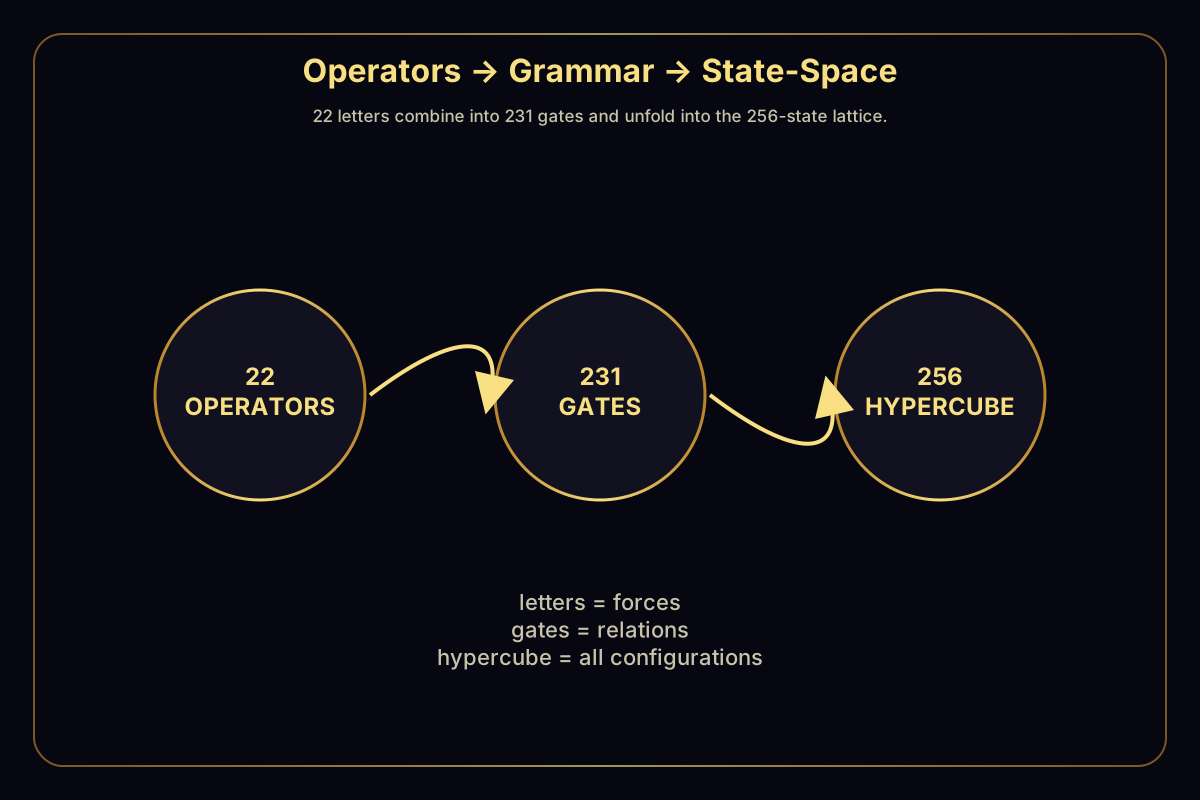
Most oracles are lookup tables — a fixed meaning stored for each symbol. This one derives its reading: each of the is an with an element, a force, a role and a class, and a is what happens when two operators meet. That is why it can answer for pairs nobody has ever written an interpretation for.
Why exactly 231?
Take 22 letters and count every possible pair without repeating one: 22 × 21 ÷ 2 = 231. That arithmetic is two and a half thousand years old — it is the count the gives — and it is exact. What each pair means is the interpretive part, and that is what this page computes.
An oracle for the 231 letter-pairs. Ask a question and it opens one gate for you; or pick two letters yourself and read that gate directly. Either way the four paragraphs you get back are assembled out of the two letters' own attributes at the moment you ask.
What it computes
- 01If you asked a question: the question text and today's date are hashed together into a number, and that number picks one of the 231 gates. Same question, same day, same gate — no randomness at all.
- 02Put the two letters in canonical order and find the gate's index: pairs are numbered (1,2), (1,3) … (1,22), (2,3) … which makes 231.
- 03Look up whether the corpus has a name for that force. 128 of the 231 carry one; the other 103 are answered anyway, which is the whole point of deriving rather than looking up.
- 04Build the gate from the two letters' forces, roles and classes.
- 05Build how it moves from the element pair — Fire+Water is steam, Air+Air is pure signal, and so on for all ten combinations.
- 06Build working it from the two tarot cards, the two astrological rulers, and the gematria sum reduced to one digit.
- 07Build its shadow from whether the two letters share a class and an element: matched pairs fail by excess, mismatched pairs fail by refusing to reconcile.
How to read it
Read the four paragraphs in order — what it is, how it moves, how to work it, how it fails. The fourth is the one people skip and the one that earns the reading: every gate has a specific way of going wrong, and knowing yours is usually more useful than knowing its gift.
What it does not claim
The count is exact and the derivation is honest — you can follow every sentence back to the two letters it came from. What is not claimed is that the resulting text is about your life. This is an interpretive instrument: it will not tell you anything it was not given, and the meanings assigned to the letters are traditional correspondences (), not measurements. A drawn gate is a prompt for reflection, not a prediction.
The draw is deterministic. Your words and today's date are run through a fixed hash, so the same question asked twice today opens the same gate twice — you cannot shake it until you like the answer. Tomorrow it moves. Nothing you type is stored or sent anywhere. One honest detail about “tomorrow”: the date used is the UTC date, so the gate turns over at midnight in London, not at midnight where you are. If you are in the Americas your gate changes during the evening; if you are in Asia or Australia it changes during the day. That is the same clock for everyone on Earth, which is the point — but it is not your clock, and nobody had said so.
What is an operator, exactly?
It is the single move that makes this system generative rather than a dictionary. In most symbol systems a letter means a thing: Aleph means air, full stop. Here each letter is a verb with a full attribute bundle — an element it works through, a force it carries, a role it plays, and a class it belongs to.
Once a letter is a verb, two letters can be composed, the way you can compose any two verbs. That is what a gate is, and it is why this oracle can answer for pairs nobody has ever written about — it does not need a stored meaning, it needs two operators and the rules for putting them together. The 22 Letters sets out every bundle in full.
Where do the 231 gates come from?
The idea is far older than this site. The Sefer Yetzirah — the “Book of Formation,” a short Hebrew text whose date scholars still argue about (estimates run from roughly the second century to the early Middle Ages, with the first surviving commentaries written in the 900s) — describes the 22 letters fixed on a turning wheel and combined two at a time, every letter paired with every other. It calls those pairings gates, and it treats the letters not as marks for writing but as the working parts of creation itself: the world, it says, was formed through their combinations. That is the root of this page's whole approach — letters as forces, pairs as events.
Even the count was argued over, which is worth knowing because it shows the tradition taking the arithmetic seriously. 22 letters taken two at a time gives 231, and that is the number most versions of the text state — but some manuscripts read 221, and some commentators counted each pair twice, once in each direction, for 462 gates running “forward and backward.” The combinatorics were treated as something to get right, not just a poetic image.
The gates were also practiced, not merely counted. In the 1200s the ecstatic branch of — Abraham Abulafia is the famous name — built a whole discipline of letter combination: reciting and permuting pairs of letters with controlled breathing and movements of the head, as a ladder into visionary states of mind. And in folklore the gates carry a wilder reputation: the golem legends, in which a figure of clay is brought to life by reciting letter combinations over it, name the Sefer Yetzirah as their instruction manual. That is legend, not history — but it preserves the tradition's central claim about the gates: combining letters is not describing the world, it is doing something to it.
What this page adds to that inheritance is exactly what the card itself says: the 231 count is the ancient, exact part; the attributes each letter carries are traditional correspondences; and the four paragraphs of a reading are this system's own computed interpretation, not a surviving ancient meaning. The tradition supplies the wheel — the reading of each turn of it is the modern layer, and it is labeled as such.
Why the same question gives the same gate
Because a shuffling oracle is not an oracle, it is a slot machine. If pressing the button again gave you a different gate, you would press until you liked the answer, and the reading would be worth exactly nothing.
So the draw is deterministic: your question text and today's date go into a fixed hash function, and the number that comes out picks one of the 231. No random number is generated anywhere. Ask the same thing tomorrow and the date has changed, so the gate has changed — the question gets one answer per day and you have to sit with it. The “day” is the UTC day, the same one everywhere on Earth, so two people asking the same question on opposite sides of the world get the same gate. The cost of that is that the roll-over lands in your evening rather than at your midnight if you live west of Greenwich.
Changing so much as a comma in your question changes the hash and therefore the gate. That is not a flaw; it is the honest form of the thing. The oracle is a mirror with rules, and the rules are printed above.
The words on this page
How to sit with a drawn gate
Go further