The Rosetta Translator
Enter any term from any tradition — a letter, a card, an angel, a sign, an element, a frequency — and read it in every other
The claim behind this tool: , tarot, astrology, the elements and the harmonic ladder are different notations for one structure — so any term should translate into any other. Every correspondence returned here is computed from the datasets, never typed in by hand.
Indexed: 22 letters · 231 · 72 · 10 · 36 — 371 entries in all, cross-linked across 11 correspondence keys, covering 10 of the 18 domains.
One thing to know before you type. Those 11 keys are not 11 kinds of entry — only five of them have rows of their own here: letters, angels, sefirot, decans and gates. Tarot, sign, element, planet, number and frequency appear as answers, never as questions. So searching Fire works — but it returns the letters and angels that carry Fire, badged Letter and Angel, rather than an entry called Fire. That is the index doing exactly what it should; it is just not what the badges lead you to expect.
What is this page claiming?
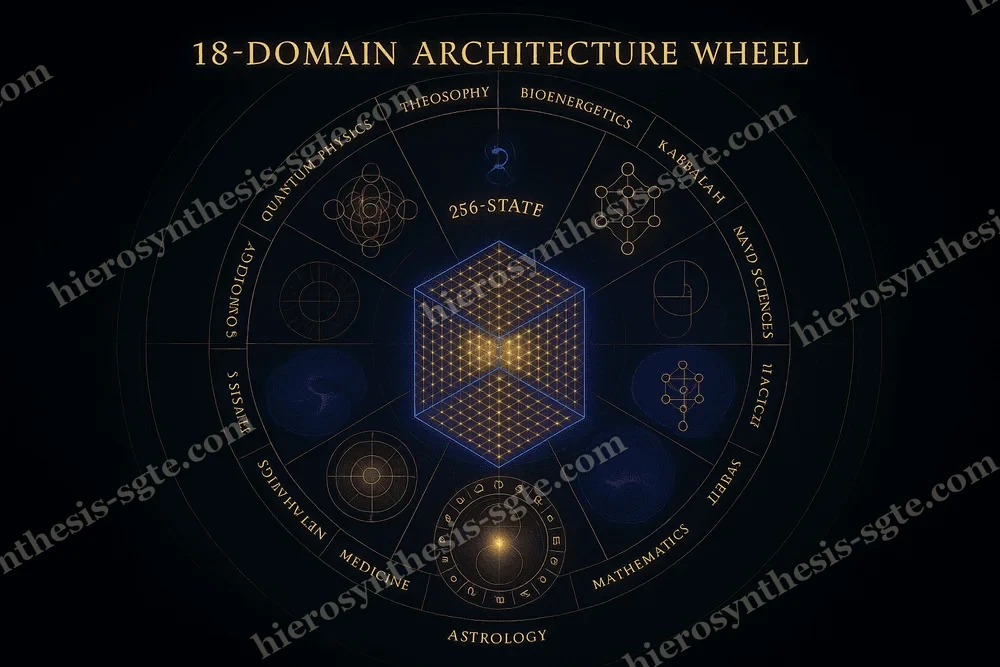
The central claim of this system is that Kabbalah, tarot, astrology, the elements and the harmonic ladder are not separate traditions — they are different notations for one structure. argues that claim across , and the full list is in the next drawer: naming them is the point, because a claim of universal correspondence that never says correspondence between what is not a claim at all.
If the claim holds, any term should be translatable into any other. This is that translator, and every correspondence it returns is computed from the datasets, not typed in by hand.
What are the eighteen domains?
Eighteen fields, 34,292 source files behind them. ● live in this translator · ○ documented in the corpus, not yet queryable here. Eighteen was not chosen for — Book I, ch. 4 argues it is simply the number of fields with enough working depth behind them to make structural rather than surface claims.
The eight unwired domains are not missing from the work — they are the parts whose datasets have not been reduced to a queryable index yet. Hover any row for its one-line gist.
Why is it called a “Rosetta”?
The original is a slab of dark stone carved in 196 BC with a decree honouring the young Egyptian king Ptolemy V. The decree itself is ordinary — temple honours, tax relief — but it was carved three times on the one stone: in Egyptian hieroglyphs, in Demotic (the everyday Egyptian script of the time), and in ancient Greek. In 1799, French soldiers rebuilding a fort near the delta town of Rashid — Rosetta, to Europeans — dug it out of the rubble, and scholars realised at once what they had: the same message in a script everyone could still read and a script no one had read for well over a thousand years.
Because the Greek was understood, it became the anchor. Jean-François Champollion worked from it, alongside other bilingual fragments, until in 1822 he could announce that hieroglyphs were readable again. Ever since, “a Rosetta stone” has meant any key that lets one system be read through another: the same content, several notations, one bridge between them.
Western esoteric writing has kept tables in exactly that spirit for centuries. In the 1530s the Renaissance scholar Heinrich Cornelius Agrippa printed tables matching letters, planets, elements, numbers and angels to one another; in the mid-1800s matched the 22 tarot trumps to the ; and built much of its curriculum on correspondence tables tying letters, trumps, planets and signs together. Those tables famously disagree in places — Lévi and the Golden Dawn assign several trumps differently — and wherever a join in this translator rests on such a contested assignment, that choice is inherited from the datasets rather than settled here.
One honest limit of the metaphor is worth keeping in view. The actual Rosetta Stone worked because one of its three versions was already understood — a known language anchored the unknown ones. A table of esoteric correspondences has no outside anchor like that: it is a proposal that these systems line up, applied consistently. That is what this translator shows — one set of stated choices, computed the same way every time — which demonstrates internal consistency, and deliberately claims nothing more.
Go further