◰ Pyramid of Conviction
The Claims Ledger — every assertion this project makes, rated for . In plain words: a list of the twenty things the system says, each stamped with how sure anybody is allowed to be about it, written by the author about his own work.
Both — clearly labelled. They serve different functions.
Pick a tier or search, then click any claim to open its full statement and formula. Every entry was written and rated by hand — the page only counts and filters.
The bars widen to show rank, not size. Tiers B and C both hold five claims and are drawn at different widths — this is a legend for the ordering, not a bar chart of the counts.
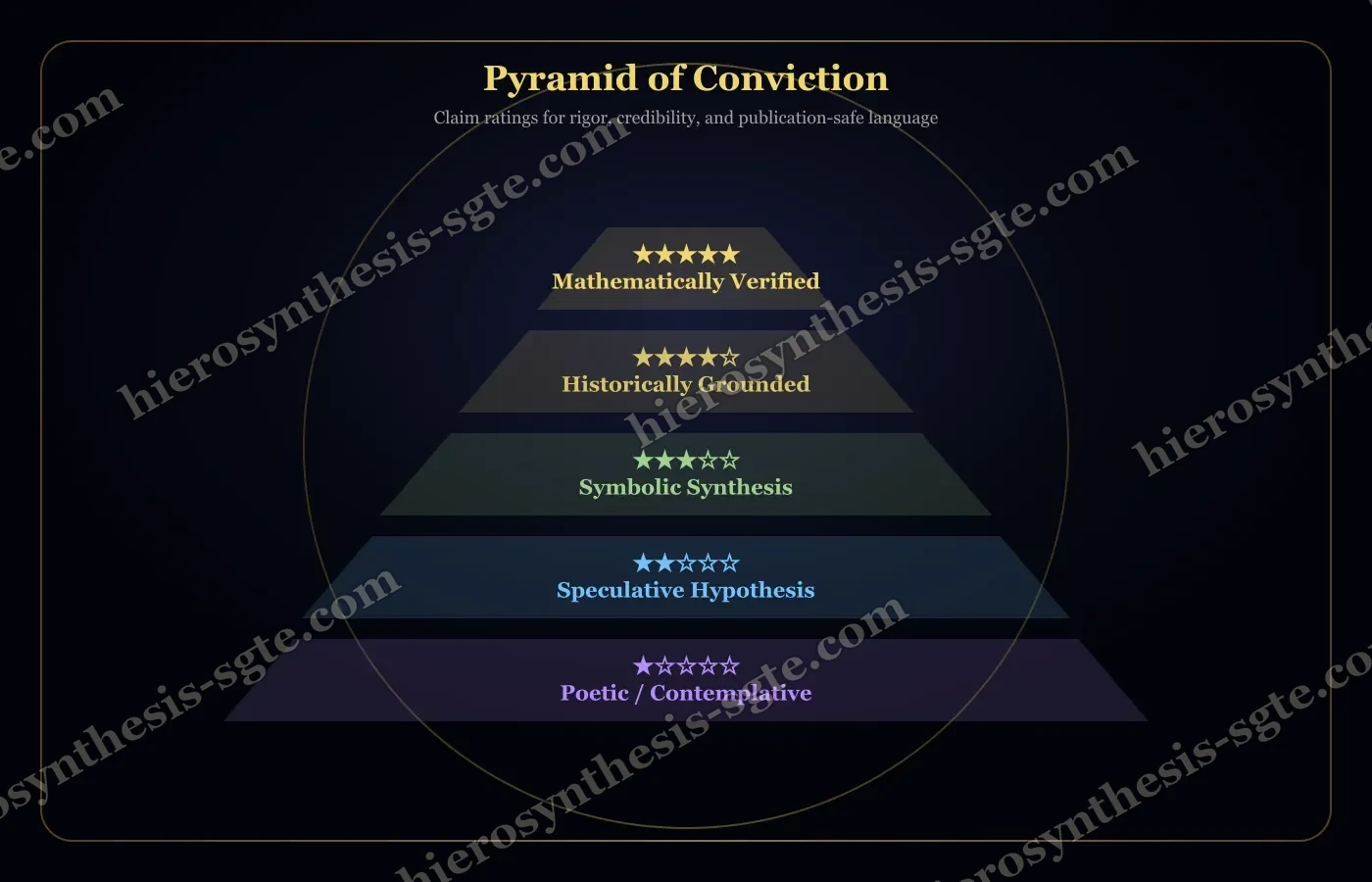
The plate has five bands. This ledger has four letters.
Two of the pairings are unmistakable: the plate’s Mathematically Verified is this ledger’s Tier A, and its Speculative Hypothesis is Tier D. In the middle the plate names Historically Grounded and Symbolic Synthesis where the ledger names Structural Constructs and Correspondences — close enough to be the same idea, not close enough to be called identical without the author saying so.
And the plate’s bottom band, Poetic / Contemplative, has no letter in this ledger at all. So either the ledger is missing a Tier E for the claims that are offered as poetry rather than as assertions, or the plate keeps a band the ledger deliberately dropped. Which of those it is has never been written down anywhere in the corpus. It is flagged here rather than guessed at, the same way the Canon page handles every other disagreement the work has with itself.
Why grade the claims at all?
Because “true” is not one thing. C(22,2) = 231 is arithmetic — anyone with a pencil can recheck it, and it will still hold next century. “The heart resonates at 432 Hz” is a different kind of sentence wearing the same grammar. The pyramid exists to stop those two kinds of sentence from borrowing each other's authority. That is also why the same arithmetic can appear twice at different tiers: A2 and D4 state the identical sum, and the tier grades the interpretation bolted on top, not the numbers underneath.
The high tiers hold the oldest material — the story told in full on the Framework page. The fall out of pairing the every possible way, a count the arrived at centuries before modern notation existed; the really does draw 10 joined by 22 paths; the really are assigned 5° arcs that close the 360° circle. What keeps most of this at Tier B rather than Tier A is honest bookkeeping: the counting is certain, but deciding what the counts correspond to is a choice people made — and interpretation is graded as interpretation.
The Tier C claims are younger than they sound. The romance of 432 traces to the nineteenth-century pitch wars, when concert tuning varied city by city — France legislated A = 435 in 1859, Verdi campaigned for a lower standard, and A = 440 only won internationally in the mid-twentieth century. None of that is ancient, and the classical Indian texts that describe the chakras give them petals, elements and seed syllables — never a number in hertz, a unit that did not exist until the modern era. Pairing chakras with frequencies, and placing planetary chakras at Shasta or Uluru, are twentieth-century syntheses. The is the interesting middle case: a real, measured piece of atmospheric physics — predicted in 1952 and detected within a decade — that later writers adopted as a bridge between body and planet. The measurement is Tier A physics; the bridge is Tier C interpretation, which is exactly how the ledger files it.
Tier D is where the system borrows the hardest mathematics. is a real and celebrated structure — 248-dimensional, with 240 roots, a distinction the ledger's own notes flag — and “operators on a Hilbert space” is real quantum machinery. Esoteric writing has reached for physics vocabulary for at least a century, and the honest way to do it is the way a pyramid does: admit that the mathematics is certain, the analogy is attractive, and the bridge between them is an open hypothesis with no test yet. A Tier D label is not an apology — it is a claim wearing its confidence on its sleeve, which is the entire point of this page.