⬡ 231 Gates Engine
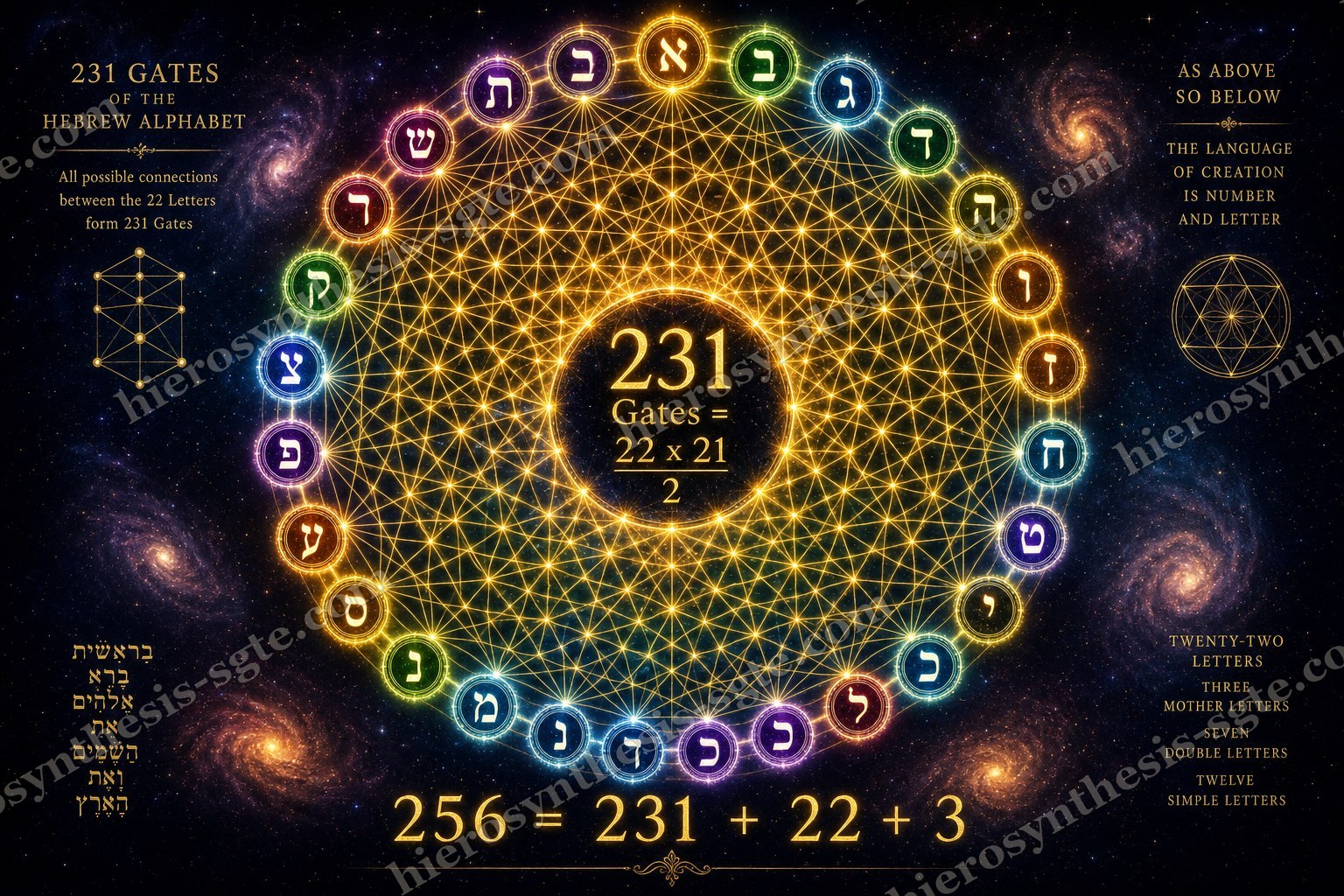
Every unique letter-pair is a gate. C(22,2) = 231 total.
In plain words: take the 22 Hebrew letters, pair every letter with every other letter once, and you get 231 pairs. “C(22,2)” is just the maths shorthand for choose two out of twenty-two. Each pair is called a gate — a doorway where two letter-forces meet — and this page lets you open any of them and read what the meeting does.
One subject, four resolutions
A gate is what happens when two letter-operators meet. Take the twenty-two letters and pair them up every possible way — counting each pair once, whichever way round it comes — and you get exactly 231 gates, no more, no fewer. That number isn’t chosen, it falls out of the alphabet itself, which is why it recurs everywhere in this system. This page is the full map of those 231 pairings.
What it computes
- 01Every possible pair of the twenty-two letters is listed in one fixed order — the first letter with the second, the first with the third, all the way through, then the second letter with the third, and onward — so every gate keeps the same number, 1 to 231, every time you visit.
- 02Order doesn’t matter: Aleph with Bet and Bet with Aleph are the same gate. If you counted both directions separately you’d get 462; counting each true pairing once gives 231.
- 03Each gate inherits both letters’ attributes — the two elements give its elemental mix, the two classes give it (or deny it) a natural direction.
- 04Where the corpus records a tribrid entry for a gate, it adds a named force, an alchemical stage and a breath signature; the 231 are divided into Nigredo (1–33), Albedo (34–66) and the stages beyond.
- 05The network view draws all 231 connections at once — each letter is a point, each gate a line between two of them, so the whole space of pairings is visible as one web.
How to read it
Read a gate as an interaction, not a thing. The elemental mix tells you what kind of interaction it is (combustion, dissolution, compaction), and the class pairing tells you whether one term leads or the two simply amplify each other. Two letters of the same class produce a gate with no internal hierarchy — powerful, and prone to running away with itself.
What it does not claim
231 is a fact about the alphabet — twenty-two letters paired two at a time, and nothing more. It is not evidence that the number is significant elsewhere. Where you see 231 recur in another domain on this site, treat that as a pattern worth examining, not as a proven connection; the evidence tiers page states which of those recurrences are load-bearing and which are only suggestive.
The Sefer Yetzirah class partition.
System B — row-major C(22,2), giving exactly 231 gates.
The 231 are listed in one fixed order, and the order is not a choice anyone makes twice. Aleph’s twenty-one pairings come first — gates 1–21. Then Bet’s twenty remaining pairings, 22–41. Then Gimel’s nineteen, and so on down to Shin with Tav, which is gate 231. 21 + 20 + 19 + … + 1 = 231, which is the same 231 you get from 22 × 21 ÷ 2. Because the order is fixed, gate 137 is the same two letters today, tomorrow and in any reading anyone has ever been sent — and when you open a gate below, the page shows you the arithmetic for that particular number so you can check it.
Two ways in. Pair Selector: pick any two letters by hand and read the gate they make. Gate Network: see all 231 at once as one web, and light up any letter’s twenty-one.
Tap a letter, then a second one — when you tap one, its name, family and operator appear in the slot above. The colour is the letter’s element; on a desktop, hovering a tile shows the same at a glance.
The families: Mother letters are the three elements, Double letters are the seven planets, Simple letters are the twelve signs. Every letter has its own page at The 22 Letters.
231 unique gates await.
The four numbers this page runs on, and where each one comes from.
Every gate joins two letter-families. Because there are 3 Mothers, 7 Doubles and 12 Simples, the six family-pairs have fixed sizes that add up to 231 — the canonical split, counted live from the letter table.
Tap or hover a row for what that family of gates is. The 84 Double × Simple gates are .
A gate is two letters meeting. To know what a gate does, know the letters — and to see which gates your chart opens, start with your own birth date.