The Name Engine
Decompose any name into its letter-operators and read its elemental signature
If each letter is an — carrying an element, a force and a role — then a name is not a label. It is a sequence of operations, and its balance can be measured: which elements dominate, which are absent, which forces repeat.
This takes a name written in ordinary Latin letters, converts it to Hebrew, and reads the result as a chain of operators rather than as a word. Everything below is simple counting and looking things up in a fixed table — there is no hidden interpretation layer and no randomness. Type the same name tomorrow and you get the same answer.
What it computes
- 01First the name is tidied: capitals become lowercase, and anything that isn’t a plain letter — spaces, punctuation, digits — is dropped.
- 02Each remaining letter is matched, one at a time, to one of the twenty-two using the same fixed table every time: a→Aleph, b→Bet, z→Zayin, and so on. Several Latin letters share one Hebrew counterpart — c/g→Gimel, e/h→Heh, f/u/v/w→Vav, i/j/y→Yod, s/x→Shin.
- 03Each Hebrew letter then brings its full profile from the 22-letter table — its element, force, role, class, tarot trump and number.
- 04The four elements are tallied across the letters and shown as proportions. Any element that never appears is reported as absent.
- 05The letters’ numbers (the traditional values: 1–10, then 20–100, 200, 300, 400) are added up. Then the digits of that total are added together, again and again, until a single digit remains.
- 06The first two letters are read as a gate — which of the 231 pairings it is, and what that pairing means.
How to read it
The dominant element is what the name reaches for first; the absent element is the quality it has to source from outside itself, which is the part most people find useful. The reduced number is the root the rest of the system keys on. The opening gate describes how the name begins — the first operation it runs — not its whole character.
What it does not claim
This is a positional letter map, not real transliteration. It reads character by character, so digraphs are split — sh is treated as Shin followed by Heh rather than as a single ש, and ch as Gimel followed by Heh rather than ח. Vowels are mapped to letters, which Hebrew orthography would not do. Because several Latin letters collapse onto one Hebrew letter, spelling information is lost — and 4 letters (Chet, Tet, Samekh, Tzaddi) cannot be produced from a Latin name at all, so no name here will ever show them. A traditional transliteration would give a different spelling and a different number — and this site runs one, by sound, on the Word Decoder, which is why the same name can carry two gematria totals here. Read this as one stated convention applied consistently — not as a fact about Hebrew, and not as a fact about the person carrying the name.
Gematria — what it is, and how to do it yourself
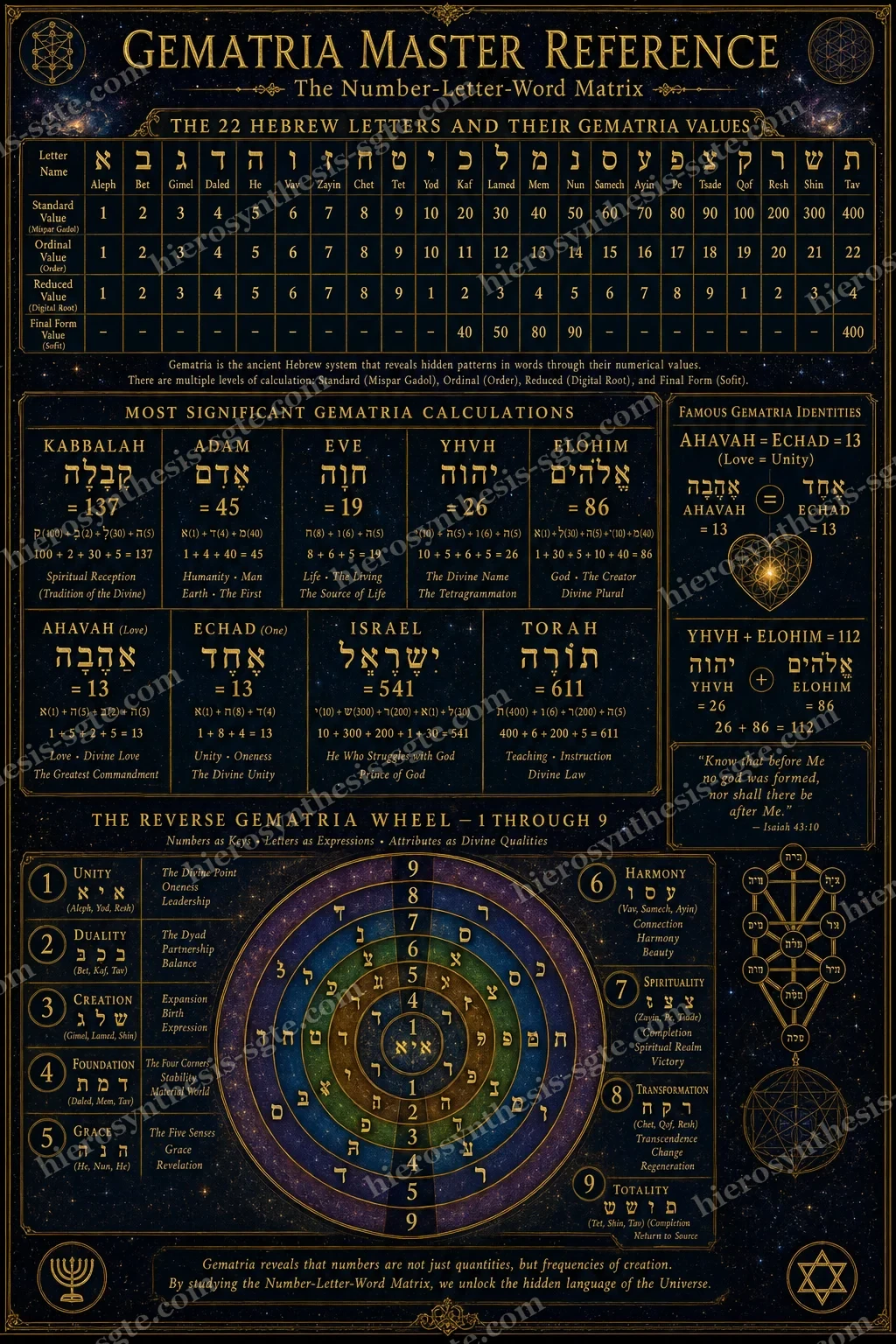
Hebrew has no separate digits. The same twenty-two letters serve as the number system, so every letter carries a fixed numeric value: aleph is 1, bet is 2, and so on — 1 through 9, then 10, 20, 30 up to 100, then 200, 300, 400. Gematria is simply adding those values up. A word’s gematria is the sum of its letters. Nothing more mysterious than that; the interpretive move comes afterwards, when two words sharing a sum are treated as related.
Do it by hand: write the word out, look each letter up in the table below, add the values, then reduce — keep summing the digits until one remains (316 becomes 3+1+6 = 10, then 1+0 = 1). That single-digit root is what the readings key on. Elsewhere in this system 11, 22 and 33 are held as master numbers and left unreduced; here the reduction runs all the way down, so a name summing to 11 reports as 2.
The full value table · all 22 letters
Why would a name have a number at all?
Because Hebrew letters double as numbers, and have for over two thousand years. The alphabet had no separate digit symbols: Aleph counted 1, Yod counted 10, Qof counted 100, and scribes wrote sums with the same twenty-two characters they wrote words with. Once letters and numbers share one alphabet, every word adds up to something whether anyone intends it or not — and people noticed. Counting words this way is called , and the habit is even older than Hebrew’s use of it: an Assyrian king boasted of building a wall whose length matched the number of his own name, and Greek speakers played the same game under the name isopsephy — one piece of graffiti preserved at Pompeii declares love for “her whose number is 545.”
In the rabbinic world gematria became a formal interpretive tool — one of the classical listed methods for reading scripture — used to argue that two words sharing a number share a connection. And names specifically were held to carry weight: the Talmud counts changing one’s name among the acts that can tear up a harsh decree, which only makes sense in a culture where a name is treated as part of a person’s fate rather than a label on it. That is the old intuition this page inherits — not “your name determines you,” but the sense that a name is a thing made of working parts.
The parts themselves come from the , which treats the twenty-two letters as the instruments creation was carved with and sorts them into three registers — the , the , the — the classes counted under any name you type here. The same book pairs the letters into the , which is why this page reads a name’s first two letters as its opening gate. The idea that a letter can carry an element also begins there — it calls Shin a fire letter and Mem a water letter — and later Western esotericists, most systematically the , extended correspondences across the whole alphabet and matched the twenty-two letters to the tarot’s twenty-two . None of that is Hebrew grammar — it is mystical interpretation, layered over the alphabet across many centuries, and this site uses it as exactly that: an interpretive layer, not a fact about the language.
One honest caveat sits under all of it: Hebrew does not write most vowels as full letters, and there has never been a single agreed way to respell an English name in Hebrew characters. Two careful scribes could the same name differently and both be defensible. So the number a name receives here is the output of one stated convention applied consistently — which is exactly what makes names comparable across this site, and exactly why it should not be mistaken for the number of your name.
The 4 letters no name here can reach
Twenty-six Latin characters have to land on twenty-two Hebrew ones, so some Hebrew letters are left with no Latin character pointing at them. These 4 will never appear in any name you type on this page. That is a limit of the scheme, not a statement about the letters — they are as load-bearing as any other, and 78 of the 231 gates have one of them on at least one side.
Two of them are reachable by sound: the Word Decoder writes ch as Chet and tz or ts as Tzaddi. If your name contains either, it is worth running there as well.
Go further