Diagram Gallery
220 visual maps spanning , sacred geometry, quantum consciousness, and . Tap the ‹ › buttons to move through the deck — or, on a keyboard, the ← → keys.
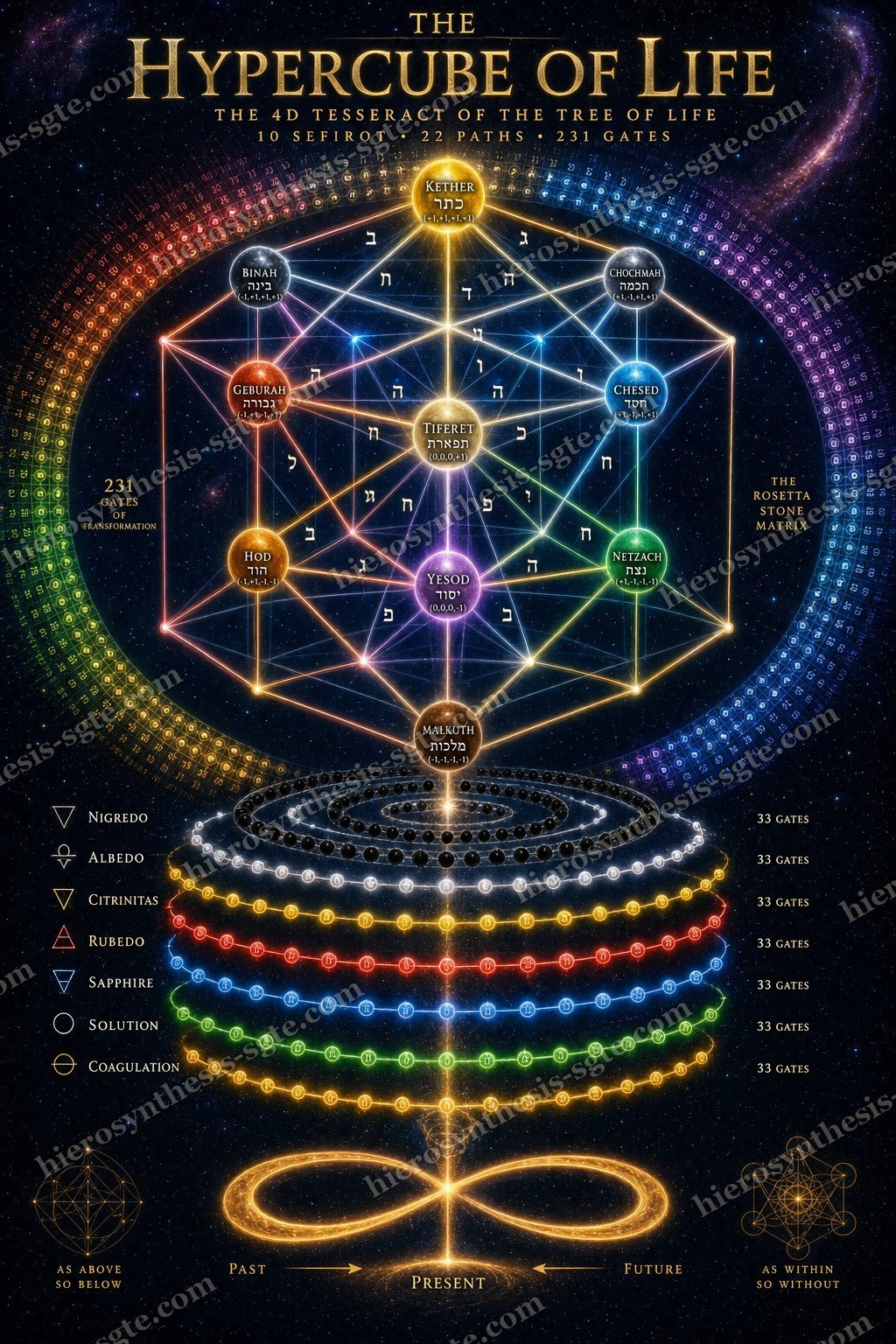
The Hypercube of Life — 4D Tesseract of the Tree of Life
10 Sefirot · 22 Paths · 231 Gates · 7 Alchemical Stages × 33 = 231
This poster folds the whole system into one image. At the top, the Tree of Life is drawn inside a 4D cube (a tesseract) — the 10 Sefirot (Kether down to Malkuth) connected by the 22 lettered paths, wrapped by a glowing ring of all 231 Gates (the 'Rosetta Stone Matrix'). Below it, the great alchemical work descends in seven colored spirals — Nigredo, Albedo, Citrinitas, Rubedo, Sapphire, Solution, Coagulation — and each stage carries exactly 33 Gates. Seven stages × 33 = 231, so the alchemical journey and the gate-count are the same thing seen two ways. At the very bottom, an infinity loop ties Past and Future into the eternal Present, under the words 'as above, so below; as within, so without.'
Open full resolution ↗The deep drawers
The gallery above stays simple on purpose. How to work the deck, what the three depth buttons mean, and where the whole idea of teaching with pictures comes from — all of that lives below, to open and close as you please.
How do I work this gallery?
Deck shows one at a time, like turning cards — the round buttons or your ← → keys move through it. Grid lays every plate out at once; click any thumbnail and the deck reopens on that exact card.
The search box matches a plate's title, its subtitle, and its tags. The small pills under it are the most-used of those tags — the last pill unfolds the full set — click one to keep only the plates that carry it, click it again (or “All”) to let everything back in. The two can be combined: a tag plus a search word narrows to plates that satisfy both.
Every card offers an Open full resolution link — the same image, full size, in its own tab — for the plates whose fine print is worth leaning into.
Beginner · Adept · Master — the three depth buttons
Most plates carry not one caption but three tellings of the same picture, and the coloured buttons switch between them. Beginner is the plain-words first pass, assuming nothing. Adept assumes you have met the site's vocabulary and starts drawing connections. Master is the deepest reading written for that plate. It is the same image every time — only how much is said about it changes.
Two honest notes: the deck resets to Beginner each time you change cards, so no plate ever opens on its hardest reading; and where you see a plain dash, that depth simply has not been written for that plate yet — the leaves it open.
Where does teaching with diagrams come from?
Traditions have always trusted pictures with the things sentences carry badly. Hindu and Buddhist practice built yantras and mandalas — precise geometric images meant to be contemplated, even mentally entered, not merely looked at — and the Pythagoreans held the tetractys, ten dots stacked into a triangle, sacred enough to swear oaths by. In every case the picture is not an illustration of the teaching; the picture is the teaching, folded small, and it opens slowly with study.
Kabbalah in particular is a tradition that begs to be drawn. The is a book of words about structure — in three families, paired every possible way into — and medieval and Renaissance commentators obliged it with letter-wheels: every letter on a circle, every pairing a chord across it. The image most people picture today is younger than the doctrine it holds. Its first appearance in print was on a 1516 Latin translation of Joseph Gikatilla's Gates of Light, and the arrangement most modern occult books descend from was drawn in 1652 by Athanasius Kircher — a Jesuit scholar rendering a Jewish doctrine, which is its own lesson in how far these images travel from home.
Renaissance and Baroque alchemy then ran on the emblem book. Michael Maier's Atalanta Fugiens (1617) gave each of its fifty teachings an engraving, a short poem, and a piece of music for three voices; Robert Fludd drew whole cosmologies as fold-out plates. The wager behind all of it is the same one this page makes: a well-made diagram compresses a doctrine into something you can hold in one look, and then repays years of unpacking. The carried the method into the modern era, revealing its teaching diagrams to initiates grade by grade, deeper images for deeper study.
The plates in this deck stand in that lineage, with the usual honesty owed: the method — letters, gates, trees, wheels — is tradition's, centuries deep; how these particular plates arrange, colour and connect it all is the author's own synthesis, and is offered as interpretation, not as something the old books say. Even the three depth buttons are this site's version of the old grade-by-grade unveiling — the same image, more said each time you are ready for it.
Go further