The Body Resonance Map
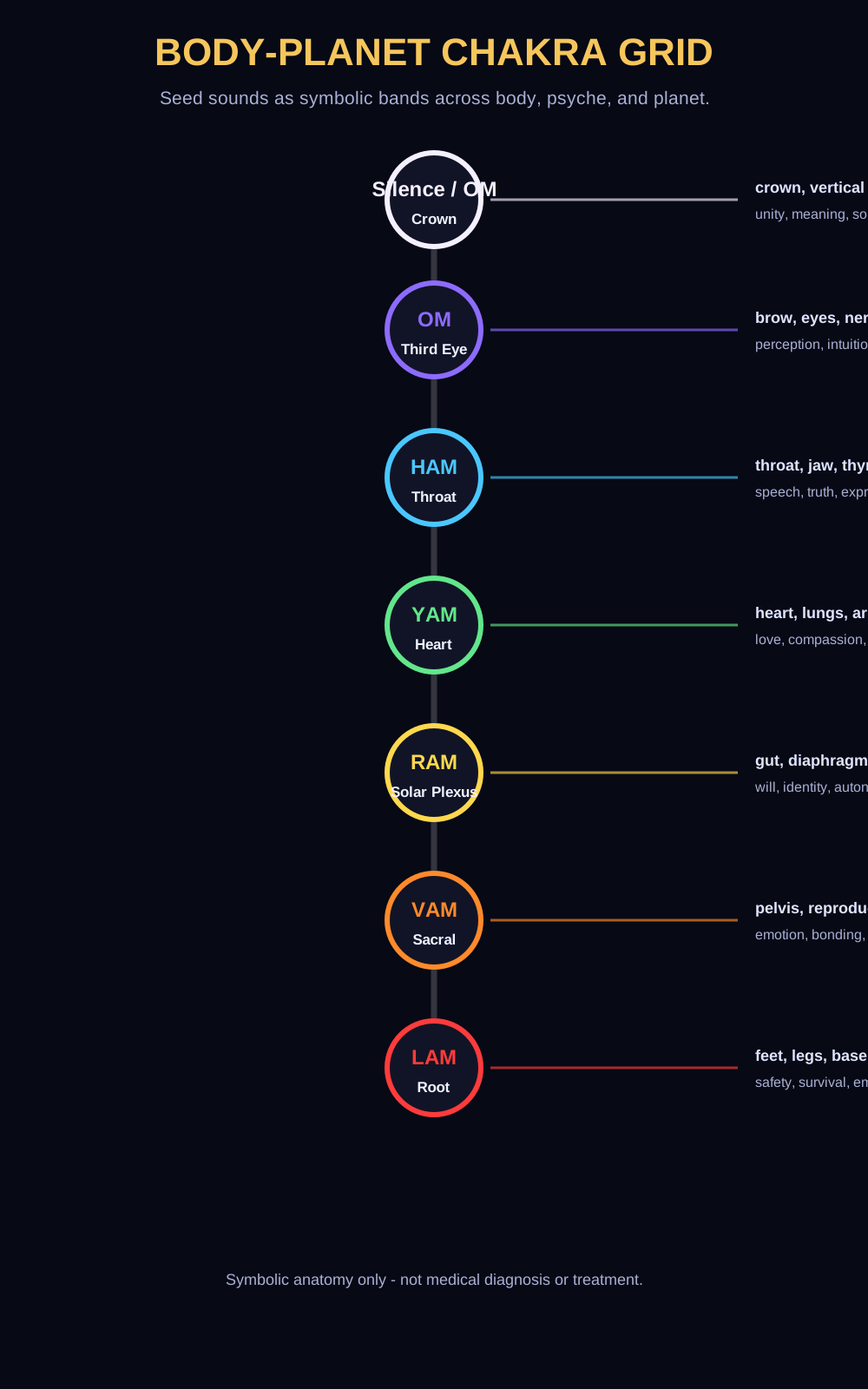
Seven centres up the spine, base to crown — the same seven the Harmonic Earth Grid pins to places on Earth. Hover or tap any centre on the figure to read what it governs, what it looks like going well, and one small thing you can do about it.
Read this first
This is a contemplative map, not a medical one. The lists further down name patterns the tradition associates with each centre — they are prompts for self-reflection, they are not symptoms, and matching one does not mean anything is wrong with you. For any physical or psychological symptom, see a doctor. Nothing on this page treats, diagnoses or replaces care.
A labelled diagram of the seven chakras, with what each governs, what it looks like in balance, the patterns tradition ties to it, and one short practice. Nothing is calculated and nothing is entered — it is a reference figure you read.
What it computes
- 01Place the seven centres up a single line from the base of the spine to the crown — the central channel, the sushumna.
- 02Give each its traditional Sanskrit name, seed syllable, colour and body region, from the chakra tradition.
- 03Attach the frequency ladder shared with the Harmonic Earth Grid, 194 Hz at the root to 480 Hz at the crown.
- 04Show, for the selected centre, what tradition holds it governs — in balance, and out of it.
- 05Offer one practice per centre: a sound, a colour, a note, and a single instruction.
How to read it
Do not go looking for the one that is 'wrong'. The useful way to read this is to start from In Tune — the description of the centre going well — and notice which ones you recognise. The imbalance lists are there to give a vague feeling a name, not to hand you a diagnosis. If a centre catches your attention, do its practice for two minutes; that is the entire intended use.
What it does not claim
Chakras are not anatomy. Nothing physical has ever been found at these seven positions, and the tradition never claimed there would be — they are a map of felt experience, roughly a thousand years old, and they are useful the way a good metaphor is useful. The frequency figures are an assigned ladder, not a measurement of tissue. The imbalance lists are not symptoms and this page cannot diagnose anything.
- Heart & circulatory strain
- Respiratory issues (asthma)
- Immune imbalance
- Upper-back / shoulder pain
- Grief
- Jealousy
- Isolation
- Difficulty giving or receiving love
What does every word on the panel mean?
Ten labels do all the work on the panel above. None of them should send you off the page.
in the Indian tradition, one of seven energy centres strung up the spine from the base to the crown. Each is tied to a region of the body, a feeling, a colour and a sound. Nothing physical has ever been found at the spots; they are a map of experience, and useful as one.
the traditional name — Muladhara, Svadhisthana, Manipura, Anahata, Vishuddha, Ajna, Sahasrara — running root to crown. Given because most older writing on the subject uses these and not the English.
the single syllable chanted at that centre: LAM, VAM, RAM, YAM, HAM, and OM at the top. You say it out loud, low, and feel where it buzzes.
hertz, cycles per second — how fast something vibrates. The seven figures here are an assigned ladder, explained below; nothing in a body has been measured at them.
the letter each practice names — C at the root rising to B at the crown, one note of the scale per centre. That C-to-B ladder is the traditional assignment, and it is not a reading off the Hz column: on a piano, 194 Hz actually lands nearest G, and 264 Hz sounds as a C, not an E. Only the upper rungs — 341, 384, 426, 480 — match their letters, and only in the older C = 256 tuning, not concert pitch. Both ladders are printed side by side on purpose; neither is quietly bent to fit the other.
the bright line up the middle of the figure. In yoga it is called the sushumna: the path the seven are strung along, base to crown.
the organs and tissues the tradition assigns to that centre. It is a mapping of meaning onto anatomy, not a statement about how the body works.
what that centre looks like when it is going well — the description to compare yourself against.
what the tradition associates with that centre being out of balance. Read them as a set of themes that tend to travel together, and nothing more — they are not symptoms of anything and they do not diagnose.
the thing you can actually do: a sound, a colour to picture, a note, and one small instruction. Two minutes is a practice; nothing here needs an hour.
Where do the Hz numbers come from?
A cycle you can count is a . A day, a year, a planet’s orbit — all of them are cycles, just very slow ones. Double a frequency and you get the same note an octave higher; double it enough times and a planetary orbit lands in the range a human can hear. That doubling trick is Hans Cousto’s “cosmic octave”, and it supplies the bottom of this ladder — and only the bottom: 194 Hz at the root is the Earth’s day octave-doubled into hearing (194.18 Hz), and 210 Hz at the sacral is the moon’s synodic month (210.42 Hz). The five rungs above them are not planetary octaves — they are musical scale steps: 341, 384, 426 and 480 Hz are F, G, A and B in the older C = 256 tuning, and 264 Hz is a C in concert tuning. Cousto gives the ladder its two lowest rungs; a scale supplies the rest.
The doubling is exact arithmetic. Which number belongs to which centre is the assignment, and it is not the only one in circulation — the ladder puts the crown at 963 Hz rather than 480. This site uses the 194–480 set, the same one the Earth Grid uses, so the two maps can be laid over each other.
How sure is each part?
Where does the chakra system actually come from?
The word chakra is Sanskrit for “wheel”. The centres come out of the tantric traditions of medieval India — the earliest texts that describe systems like this date from roughly the eighth to the eleventh century. And those texts do not agree on one map: different lineages worked with four, five, six, nine, even twelve centres. Seven is one system among several — the one that happened to become standard, not the only one the tradition ever drew.
The reason the old teachers were relaxed about rival maps is the biggest surprise for modern readers: in the original practice a chakra was something you built, not something you found. A practitioner visualised the centre at the named spot, installed a syllable — the — and often a deity there, and used it as a station for meditation. The maps were tools of practice, not reports about anatomy, so two schools could hold two different maps the way two gyms hold two different training plans. The force said to rise through the centres along the is what the texts call kundalini — pictured as a coiled serpent asleep at the base of the spine.
The seven-centre map most people know reached English in 1919, when Sir John Woodroffe, writing as Arthur Avalon, published The Serpent Power — a study of two Sanskrit texts, the main one written in the sixteenth century. Nearly everything else on the familiar poster is newer still: the rainbow of colours running red to violet was popularised in the 1970s, and the pairings with glands, musical notes and psychological life-stages are twentieth-century Western additions. Old practice, new paint — which is not a dismissal; it is just worth knowing which layer you are looking at.
This page keeps both layers and labels them. The centres, Sanskrit names, seed sounds and body regions are the old tradition; the colours, the note ladder and the Hz figures are the modern layer, and the “How sure is each part?” drawer above marks which is which. The site works with the seven-centre version because that is the one the rest of this corpus is built on — the same seven the Harmonic Earth Grid pins to places on Earth, and the same seven that run through the correspondence tables.
Go further
The body-system, “in-tune” and imbalance correspondences on this page are a symbolic and contemplative framework drawn from the chakra tradition — a lens for self-reflection and resonance practice, not medical diagnosis or treatment. For any physical or psychological symptom, consult a qualified healthcare professional.