The Gate Reader
Every pairing of two letters is a gate. Walk them one by one — the author's own readings marked apart from the computed ones.
This is the study-desk view of the gate engine — codex, stages, lenses. For a plain-language reading of the same gate, open the Gate Oracle.
Where does this name come from?
From the — a third voice, neither the author's hand nor this site's derivation. The name, paths and stage were imported; its prose was not, because it came from eleven sentence templates rather than from a writer.
Where do the 231 gates come from?
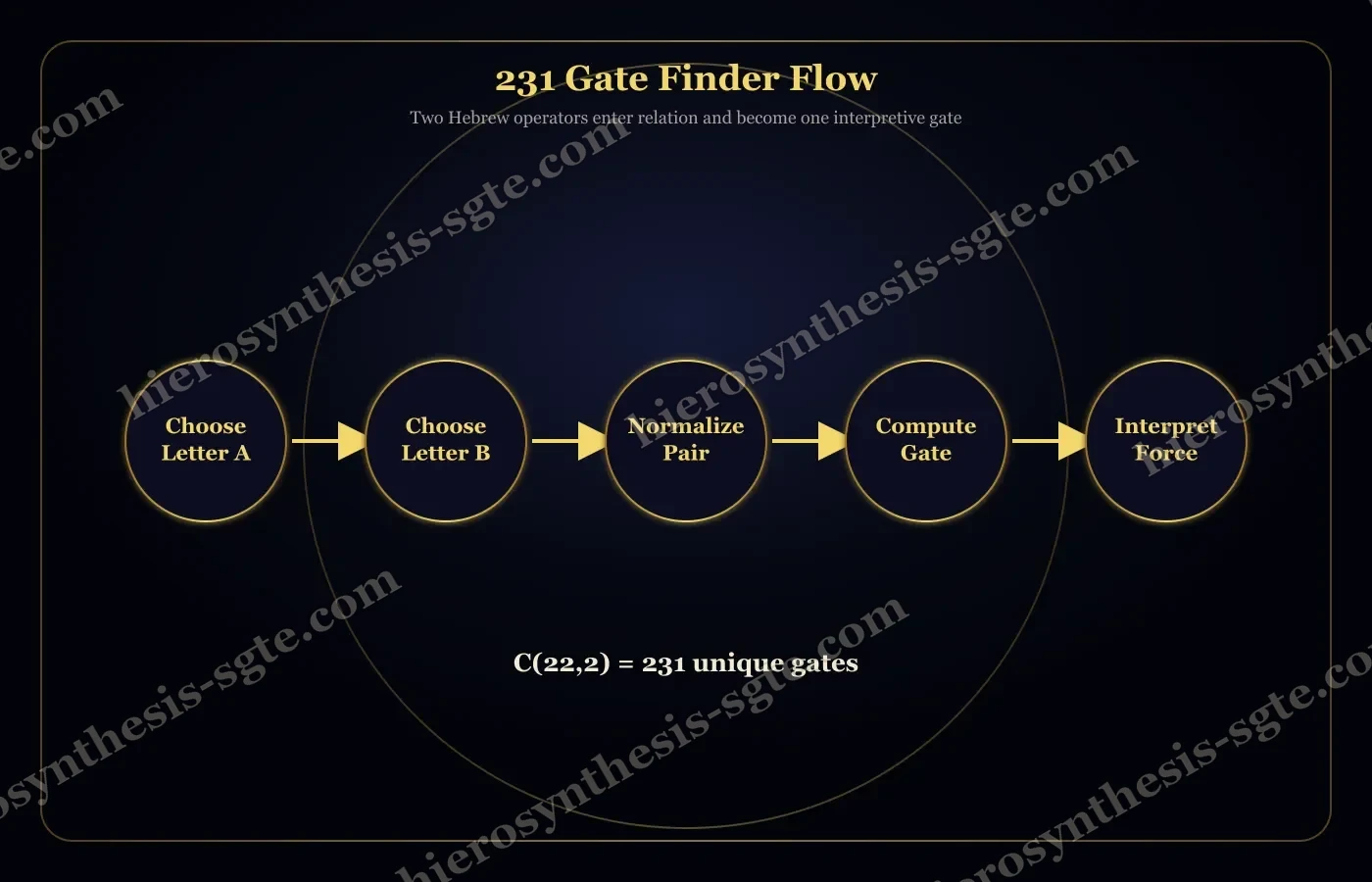
Count the doors first: , each paired once with each of the others, makes 22 × 21 ÷ 2 = 231. The idea is far older than this site. It comes from the Sefer Yetzirah — the “Book of Formation”, a very short Hebrew text whose date scholars still argue about (estimates run from roughly the second century to the seventh) — which pictures the letters fixed on a turning wheel and combined each with every other, so that creation is spoken through those pairings. A gate, in that picture, is simply the door two letters make when they meet.
The manuscripts are not tidy about it. Some copies of the text count 231 gates, others say 221, and medieval commentators argued over what the count even meant — whether a pair read forward and then backward is one gate or two, which would double the total to 462. This page walks the plain combinatorial count — every unordered pair once, 231 doors — because that is the reading the arithmetic itself hands you; the older disagreements are part of the tradition's history, and they are reported here as history rather than settled quietly.
Later treated letter-pairing as something you do, not just something you diagram. Abraham Abulafia, writing in thirteenth-century Spain, built whole manuals of meditation around permuting letters aloud with controlled breath, cycling through combinations the way a musician runs scales. And the most famous folklore attached to the Sefer Yetzirah — the legend of the golem, a figure of clay brought to life — has the creature animated precisely by working through letter combinations from this book. That is legend, and it is told here as legend; but it shows how seriously the tradition took the idea that pairing letters is an act, not an ornament.
The gates also inherit everything the letters carry. The Sefer Yetzirah sorts the twenty-two into three , seven and twelve , and tradition hangs its correspondences on those classes — elements on the Mothers, planets on the Doubles, zodiac signs on the Simples. So when two letters meet in a gate, two of those inheritances meet too, and that meeting is what every reading on this page — the author's or the machine's — is an interpretation of. The pairings themselves are arithmetic; what a pairing means is interpretation, and the page keeps the two labeled apart.
Which ones: gates 181–200, one unbroken run. The bar is not decoration and not a promise — it is the length of that run measured against 231. Everywhere outside it you get the computed reading, clearly labelled, and the “next hand-written” button walks you straight through the written ones if you want to read the manuscript rather than the machine.
Three ways to move. The slider walks all 231 in their fixed order; the two dropdowns pick the pair directly; today’s gate is dealt by the date itself, so it is the same gate for every visitor and it turns over at midnight UTC rather than at your own midnight. Next hand-written jumps to the following gate the author has written up. The numbering is the same on every gate page here — the Gate Reader, the Letter Lattice and The 231 Gates all count the same way, so a gate number you carry from one page to another means the same door.
Aleph × Bet
Air × Earth · Mother × Double · 3 → 3 · the names this “The Living House” · Nigredo stage
Reading that line: the two elements are what each letter works through; the class pair is which families they come from — Mother (an element itself), Double (a planet) or Simple (a zodiac sign); the gematria is their two number-values added, then folded to a single digit; and the stage is where the gate table files this pair in the alchemical Work.
Computed from the letters — not yet in the author’s hand
Aleph carries expansion as an elemental axis — it does not act, it *is* the ground the other moves in. Bet carries structure as a planetary switch — it can run either polarity, hard or soft. Where they meet, the initiator is put to work on the stabilizer — the corpus names this force “The Living House”.
Elementally this is structure given breath — an idea taking a body; design, architecture. A Mother meeting a Double gives the gate a natural direction: the elemental ground term sets the field, the other term moves inside it. Its breath signature is hold (top) ↔ ground.
Work it through the tarot pair — The Fool with The Magician — and the astrological pair Air/Mercury. Gematria 3 reduces to 3, and the corpus places this gate in the Nigredo stage of the Work. Practically: use Breath to open, House to complete.
Its failure mode is the two terms refusing to reconcile: expansion stalling against structure instead of passing through it.
Breath is how the gate table reads the pair as breathing — you can sit and do it. Polarity is the charge it carries: Red outgoing, Blue incoming, Neutral neither. Tarot is the two Major Arcana cards traditionally hung on these two letters — read them as a two-card spread.
On this gate the site’s two tables disagree
The elements printed at the top come from the Master Letter Table. The breath and polarity rows just above come from the 231-gate Tri-Brid table — and that table records this pair as Air×Earth. The two agree about fourteen of the twenty-two letters and part company over the other eight, which puts this seam through 140 of the 231 gates. Both are shown rather than one being quietly chosen; which is authoritative is the author’s ruling and has not been made.
Go further