Phoneme Mapper
Each root sound as a living force — its silenced, distorted & reborn states
Seven — one for each of the seven centres the Indian tradition runs up the spine. Pick a letter and the card gives its , its , and the three states this reads every sound through: silenced, distorted, and reborn.
L — Survivor → Grounder
Legs, feet, adrenals, skeletal foundation
Direction: Downward / grounding · Arc: Survival anxiety → Embodied authority
Its sound — say it out loud
LAM — the tongue strikes the roof of the mouth and stops. The most physical of the seven. It carries the base of the spine. Weight, ground, the body's contract with the floor.
What this is, and what it is not
This is a symbolic map, in the way a tarot spread is a symbolic map. The seven centres are a description of themes — safety, appetite, will, connection, voice, sight, belonging — laid out along the body because that is where people have always felt them, not because an organ was measured.
The 'stress pattern' line on each centre is the traditional association, not a diagnosis and not a mechanism. Nothing here says a chakra causes an illness, and nothing here should delay a doctor. If something in your body is wrong, that is a matter for medicine, and this page has no opinion about it.
What the map is genuinely good for: naming a state you are already in. Reading 'voice — and the specific damage of not saying it' and recognising your own week is the entire use of it.
The sounds, drawn on a body
The card above tells you where a sound lives. This plate from the archive shows it — the same idea, drawn once for the consonants rather than the seed syllables.
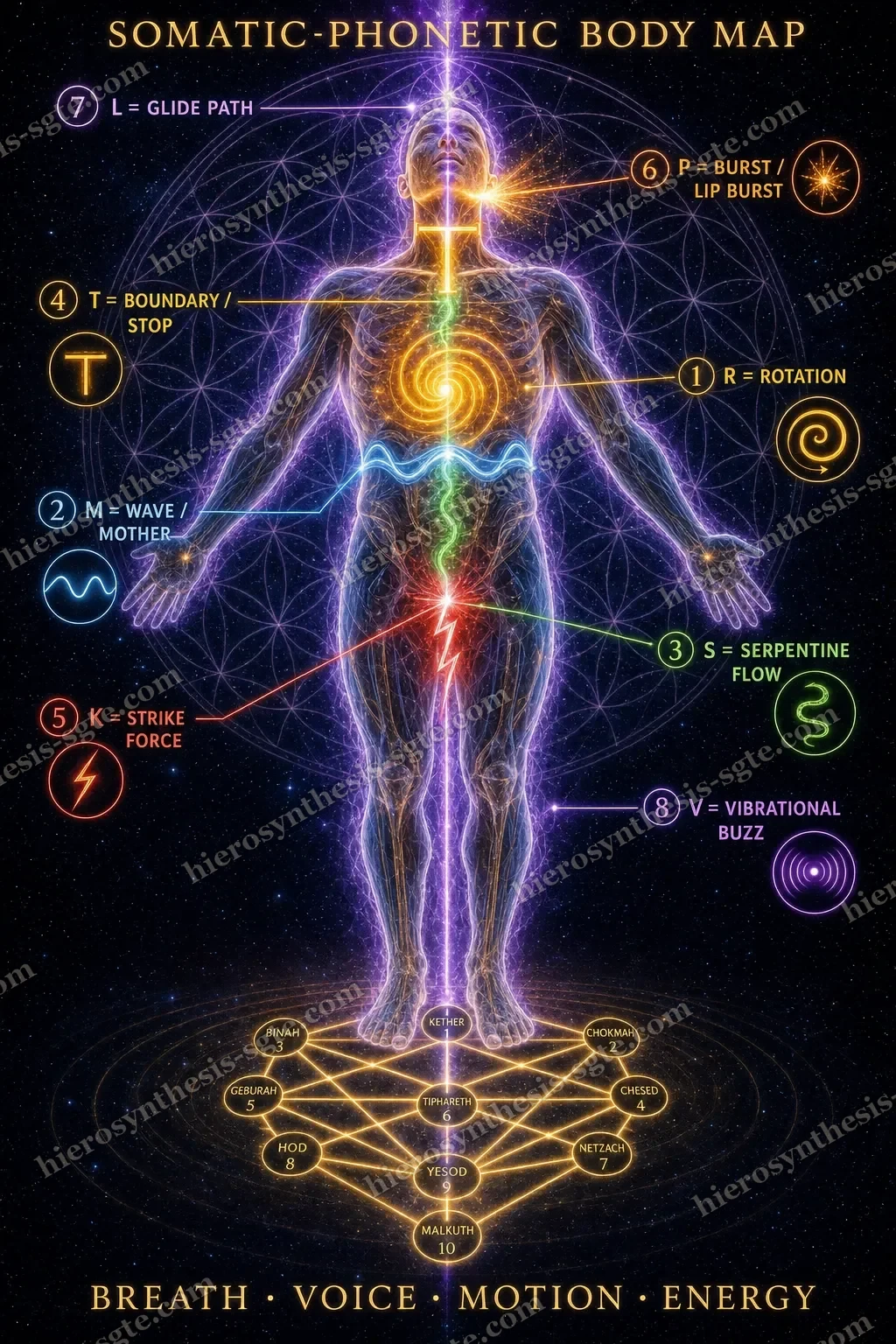
Where do these seven sounds come from?
A seed sound is a syllable with no dictionary meaning — nothing to translate, only to say. The oldest of them by far is OM. It appears in the Upanishads, the Sanskrit philosophical texts of roughly the first millennium BCE, and one short text, the Mandukya Upanishad, is devoted to that single syllable: it splits OM into A, U, M and the silence after the hum, and reads the four parts as waking, dreaming, deep sleep, and a fourth state beneath all three. Taking one sound apart and treating each piece as a state of being is not a modern idea — it is one of the oldest moves in the tradition.
The other syllables here are younger. LAM, VAM, RAM, YAM and HAM come from the medieval tantric texts — the same texts that describe the centres themselves. Each centre is pictured as a lotus with its seed syllable at the heart, set on the , the central channel of the body, and the tradition pairs the five lower syllables with the five elements: LAM with earth, VAM with water, RAM with fire, YAM with air, HAM with space. To chant the ladder from the bottom up is, in that frame, to chant the elements from the densest to the finest.
Here is the part you can check with your own mouth. Say the seven in order and notice what your mouth does: L is a full strike of the tongue on the roof of the mouth, V a buzz of lip against teeth, R a tap, Y barely a touch, H nothing but breath, and M closes the lips on a hum. Contact decreases and resonance increases — the series climbs from the most physical sound to the least, the same direction the centres climb the body. The mouth mechanics are plain description anyone can verify; reading that climb as meaningful is the tradition's move, and this page inherits it as interpretation, not as fact.
An alphabet living on the body is an idea this site meets twice. The tantric diagrams write the fifty Sanskrit letters on the petals of the centres; , the seed text of , assigns to parts of the body. The two traditions arrived at the thought separately, and the corpus sets their ladders side by side because they rhyme — not because either borrowed from the other. One honesty note to carry out of this drawer: the syllables and the centres are the tradition's; the three-state reading on the card — silenced, distorted, reborn — is this corpus's own frame laid over them.
Why do they all end in M?
The M is the hum: the lips close and the sound keeps going through the nose, which is why a held M buzzes in the skull and the chest. Practically, it is what makes a seed syllable chantable at all — the L of LAM is over in an instant, while the M can be carried for a whole breath. Chanting teachers often put it this way: the consonant at the front is the syllable's individual signature, and the hum is the common ground every one of them returns to. The Mandukya's fourth quarter — the silence after the hum — is the oldest version of the same thought.
How do I read the card?
Every line the card prints, one plain gloss each. The short version: the top half is the traditional map, the three coloured cells are the corpus's reading of the sound in a life, and the pair in the title — Survivor → Grounder — is the arc said as two characters.
Go further