One Gate, Every Projection
A gate is a pair of letters — but it is also a cell in a 22-by-22 grid, a node in a network of everything sharing its letters, and a member of a class. Same door, four ways of standing in front of it.
The site keeps two records of what element each letter is: the Master Letter Table, which every element chip and every elemental sentence on the site comes from, and the 231-gate Tri-Brid table, which the breath, polarity and frequency-band columns come from. For fourteen of the twenty-two letters they agree. For the other eight they do not, and that puts a seam through 140 of the 231 gates — 60% of them. Both are shown for every gate here rather than one being quietly picked.
Each of your two letters appears in 21 gates — itself paired with each of the other 21. Take away the one gate they both sit in (this one) and Aleph brings 20 neighbours and Bet brings 20, so every gate in the system has exactly 40 — no gate is more connected than any other. Each number below is a gate you can walk to in one step; click it to go there. Hover to see which of your two letters carries you across.
Where do the 231 gates come from?
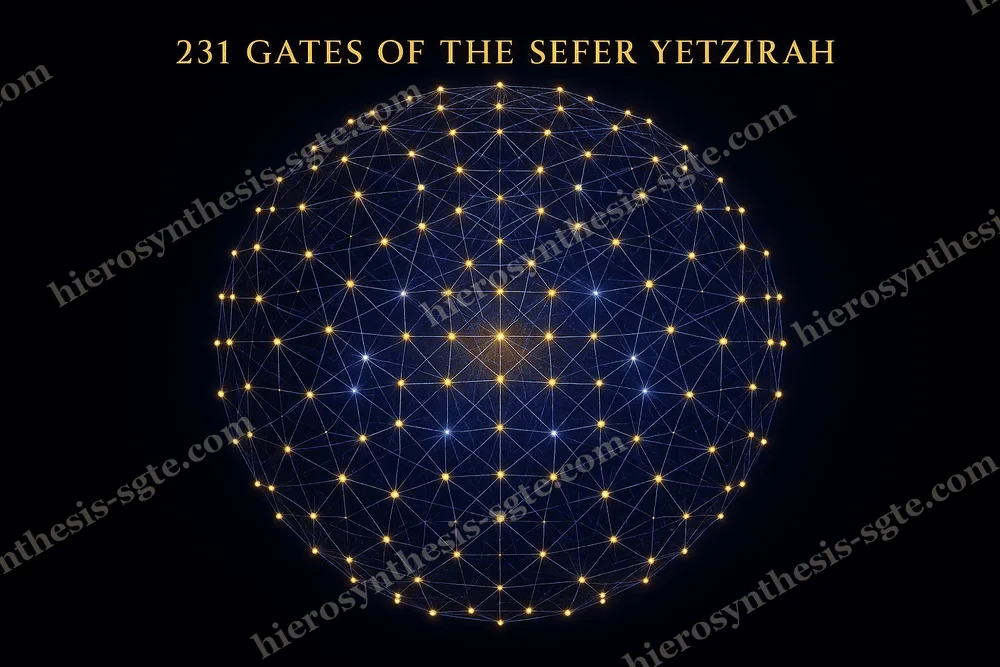
The idea behind this page is much older than any grid. The — the “Book of Formation,” a short Hebrew text on how the world was made from letters, dated by scholars anywhere from late antiquity to the early medieval period — teaches that the were carved out, weighed, and combined into 231 gates: each letter joined with every other letter, every pairing treated as a doorway through which something could come into being. The count itself is plain combinatorics — twenty-two things taken two at a time make 231 pairs. (Some old manuscript families actually transmit 221 instead; copyists and commentators argued over the number for centuries, which tells you how seriously they took the arithmetic.)
The book's own picture is not a grid but a wheel: the letters set on a circle that turns forward and back, so that every letter comes to face every other in turn. Draw all 231 pairings as lines across that circle and you get the classic gates diagram found in manuscripts and early prints. The 22-by-22 matrix on this page is the same object flattened into rows and columns, and the network view is the same object again, read from one node outward — three drawings of one structure.
The tradition did real work with the gates. Medieval commentators such as Saadia Gaon and Shabbetai Donnolo wrote arithmetic-heavy commentaries on them; the thirteenth-century ecstatic Kabbalist Abraham Abulafia turned letter-pairing into a meditation practice, cycling combinations aloud with the breath; and the golem folklore — the legend of animating a clay figure — has the maker reciting letter combinations drawn from tables like the one above. In the folklore the gates are not trivia; they are treated as the working parts of creation.
One honest note: the Sefer Yetzirah gives the count and the method, not a dictionary. It never writes out 231 individual meanings, and the traditions that follow it fill that space in different, sometimes contradictory ways. That is why every reading here is derived live from the two letters rather than looked up — the derivation is the fixed part; the interpretation is labelled as interpretation.
One number often met alongside 231: 252. It is not this page's count — it arises in the , where the 231 gates sit beside the twenty-one numbered trumps — and the next drawer holds the author's ruling on where it comes from.
Where does the number 252 come from?
252 has two official derivations and they agree. 3 × 7 × 12 = 252 — times times — is exact. And 231 gates + 21 numbered archetypes = 252: the twenty-two are twenty-one numbered cards plus one unnumbered — The Fool stands at zero — so “21” and “22” are both true statements about the same set. That is the author's ruling of 21 August 2026 (see the ), and it complements his own ordering: the Fool is zero, the Magician is one.
What the ruling retires: the reading that adds twenty-one reflexive pairs (a letter with itself) — there are twenty-two of those, which gives 253 — and any derivation that does not compute. Two derivations that agree are a proof; four that disagree were a liability.
Go further