◎ The Body Blockage Chart
The same seven-node map used to chart Earth's planetary circuit-nodes, drawn inward — the body as a seven-node field. Nothing is computed here: click any node to read it, mark any node where you feel a blockage yourself, or click through each in turn to learn the full system.
Two body charts, two ladders. This site draws the seven centres twice, and the Hz numbers differ on purpose. This chart labels each node with the modern Solfeggio tones (396–963 Hz, with 432 Hz at the heart) — symbolic tuning labels, not measurements. The Body Resonance Map uses the site's own 194–480 Hz planetary ladder, the one the Harmonic Earth Grid runs on — that ladder is the instrument the rest of the system is tuned to. Neither set is a measured property of a body; where the two pages disagree, this is why.
Click a node to view · click again below to mark a blockage you feel
Heart
Air · Governs: Heart, lungs, thymus, circulatory system, arms, hands
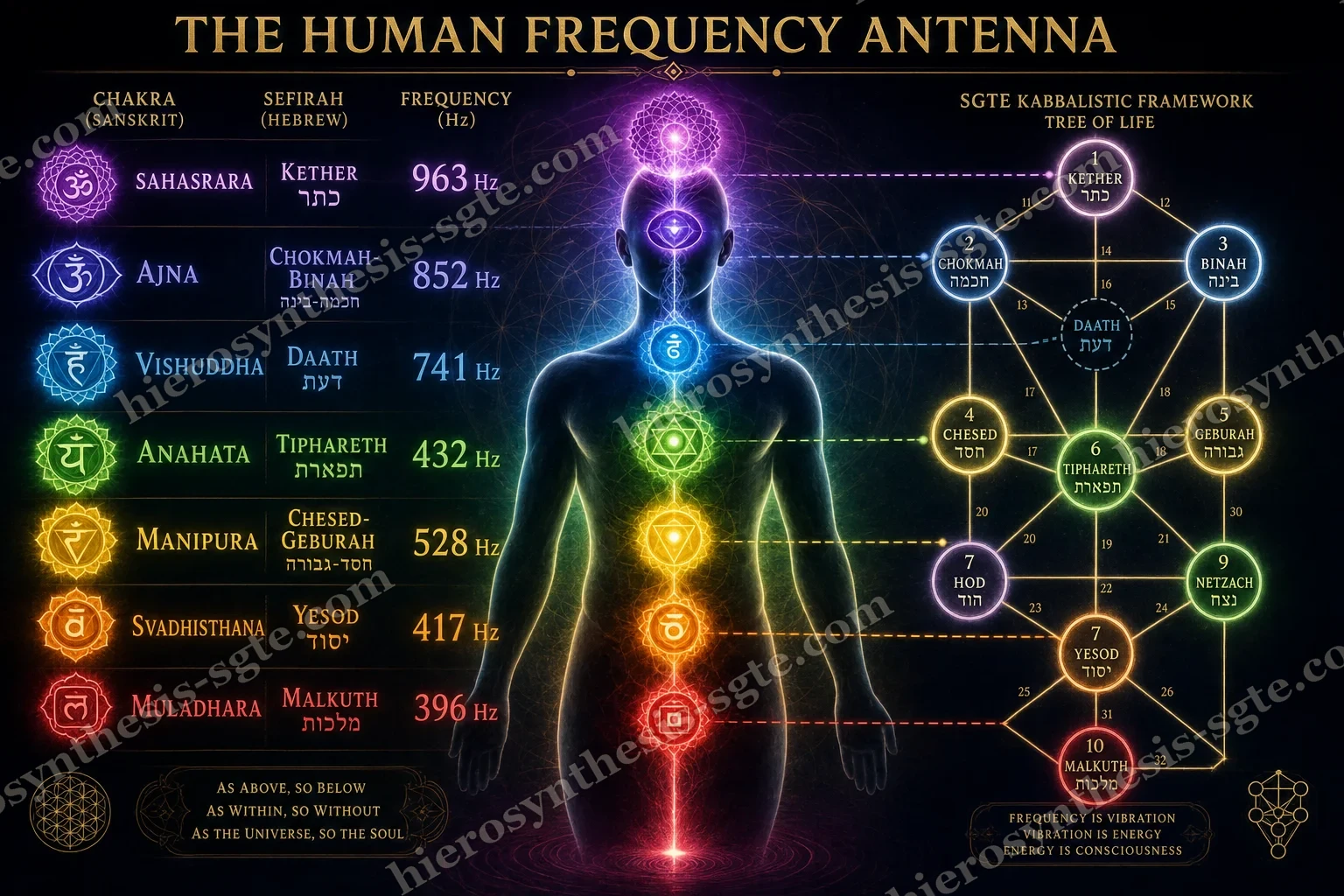
The same map, as the author drew it
One plate from the archive makes both of this page's assignments at once — the frequency ladder up the body, and the throat carried across to Da'at. Worth a look before you read the honest notes below it.
Where does the seven-chakra map come from?
The word is Sanskrit for “wheel.” The picture of spinning centres of life-force stacked along the spine comes from the tantric traditions of medieval India, where each centre was drawn as a lotus with a set number of petals, a seed-syllable to chant (a ), an element, and a presiding deity. In those sources the map was not anatomy — it was a practice diagram: something a meditator builds in the body through visualisation and sound, climbing centre by centre along the central channel, the .
Different texts count different numbers of centres — four, five, six, nine, even twelve. The seven-centre ladder used here traces to one sixteenth-century text, the Shat-chakra-nirupana, which reached English readers in 1919 through John Woodroffe's translation, The Serpent Power. That single book is the main reason “seven chakras” became the standard version in the West.
Most of what a modern reader knows on top of that is newer still: the rainbow colours, the pairing of each centre with an endocrine gland, and the psychological language of balanced / blocked / overactive are twentieth-century Western developments. This page keeps them because they work as a mirror for self-reflection — but they are interpretation layered onto the old map, and the site would rather say so plainly than pass them off as ancient.
What are the Hz numbers on each node?
The frequency beside each node comes from the modern family of tones (396, 417, 528, 741, 852, 963 ), with 432 Hz — an alternative concert pitch carrying its own modern folklore — placed at the heart. None of these numbers appear in the Sanskrit sources; the Solfeggio set was proposed in the late twentieth century. On this chart they work as symbolic tuning labels, a way to give each centre a tone — not as measured physics.
The site's other body chart, the Body Resonance Map, uses a different ladder entirely — 194–480 Hz, derived by octave-doubling planetary orbits and shared with the Harmonic Earth Grid. That ladder is the one the rest of the system is tuned to, which is why its numbers do not match these. Both sets are assignments, and the site keeps both, labelled.
How does this page connect to the rest of the system?
This chart mirrors the same node-and-circuit method used on the Harmonic Atlas and 9-Circuit Navigator — same method, human scale. Cross-reference with the Tree of Life for the full Sefirotic correspondence.
One honest note on that correspondence: pairing the seven chakras of India with the ten of is a modern Western move. The Sanskrit sources and the Hebrew sources grew up independently, and different modern authors align the two ladders in different ways. The pairing shown on each node card is the corpus's own chosen alignment, offered as interpretation — not something either original tradition states.
One seat in that alignment needs its own flag: the Throat here is paired with , which is not one of the ten Sephirot at all. Kabbalah draws it as the hidden “eleventh” station on the Tree's middle pillar — the point where the top three merge into knowledge, sitting at the throat of the pattern — and that is exactly where this system seats it. You will not find it in the Correspondence Table's list of ten, and that is why.
Go further