The 9 Circuits
From Body to Crown — the developmental spine of the Great Work
The nine circuits are the developmental spine — a single ladder that the system claims is walked by everything that grows. Each rung binds a , a planet, a , an element, an and a span of the human life arc into one position, so a stage of personal development, a stage of the Great Work and a band of the Tree are three names for the same place.
They group into three triads, described just below. Click any circuit to open its full correspondence.
Which way does the ladder run — and what a ‘circuit’ is not
Read upward it is the return — body to crown, matter refined toward source. Read downward it is — the same nine positions crossed in the other direction.
And one caution on the word: these nine are not the 14 extraction circuits — those are a research method for sorting notes, these are part of the system being described.
A reference table, not a calculator. Nine rungs are listed in fixed order and each one is shown with the eleven correspondences the corpus assigns it. Nothing here reacts to you — there is no birth date, no input, no result.
What it computes
- 01Read the nine circuits from
lib/sgte-pages.ts— the author's own table, in his own wording. - 02Print them in order, 1 (Body) at the top through 9 (Source) at the bottom, each keyed to its colour.
- 03On click, open every field that circuit carries: sephirah, planet, world, alchemy stage, life arc, tarot trump, triad, function, signature, anchoring discovery and academic domains.
- 04Nothing is computed, combined or reduced. What you see is what the table says.
How to read it
Start with Function — it is the one-verb version of the rung. Then read Life Arc to see when the material is usually being worked, and Signature for the author's own one-line summary. The other fields are the same idea restated in five borrowed vocabularies; they are there so a reader who already speaks one of them can find their footing.
What it does not claim
That a stage of Kabbalah, a stage of alchemy, a chakra and a decade of a human life are the same position is the system's central claim, not a demonstrated fact — a Tier C correspondence, meaningful as a lens and not physically established. The gate bands are exact but chosen: 7 × 33 = 231 divides cleanly, and the decision to cut the field into sevenths of 33 is the author's, not something the arithmetic forces. And the life-arc years are a template, not a schedule: nobody is late.
The three triads
The nine rungs come in three groups of three. Each group has one job, and you cannot skip a group.
Getting a self assembled: a body that survives, a feeling life that moves, a mind that can name things.
Getting that self worked: a heart that can hold opposites, a sense of where mercy ends and severity begins, and a form strong enough to keep the result.
The finished individual opening onto what is larger than it — sudden seeing, the collapse of separateness, and the source that was there the whole time.
What does every word on a circuit card mean?
Each rung is described in five different traditions at once. Here is what each label means, so no card sends you anywhere else to read it. These notes describe the field, not the value — the values are the author’s and are printed as given.
The ladder, rung by rung
Numbered from the ground up. Click any rung to open everything the corpus assigns it.
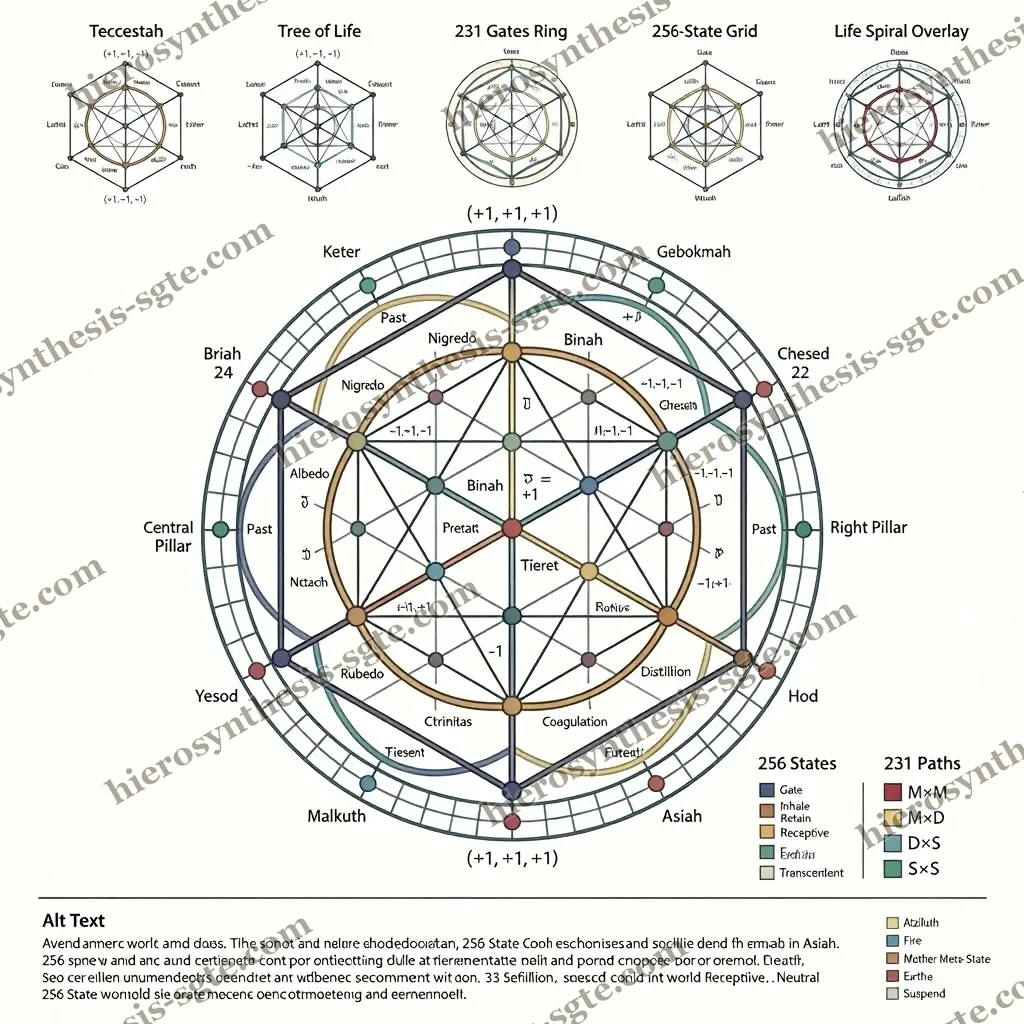
Why nine and not ten
Where does the ladder idea come from?
The picture behind this page — growth as a climb through fixed rungs — is one of the oldest images on record. Jacob dreams of a ladder set on the earth with its top in heaven. Plato has the soul rise out of shadow toward the light in stages. The Hermetic writings walk the soul up through the seven planetary spheres, shedding one quality at each. Medieval monks read John Climacus’s Ladder of Divine Ascent, thirty rungs of practice in strict order. Every version makes the same claim this page inherits: the stages come in a fixed order, and each one has to be secured before the next will hold.
The vocabularies braided here each have their own history. The Tree of Life with its ten sephirot took its familiar shape in medieval , drawing on the much older . The chakras come from Indian tantric texts, and the seven-centre version most people know reached the West largely through a 1919 translation titled The Serpent Power. Alchemy’s colour-stages — blackening, whitening, reddening, with a yellowing sometimes counted between — go back to the Greco-Egyptian alchemists. And lining the 22 up with the 22 Hebrew letters is younger than it feels: it begins with the French occultists of the 1800s and was systematised by the .
Stacking those systems on top of one another is itself a tradition. The Golden Dawn built vast correspondence tables mapping sephirot to planets to cards to letters, and that habit of tables is the direct ancestor of a page like this one. Worth saying plainly: the older texts do not make these equations themselves — no tantric source says a chakra is a sephirah. The equations are a synthesis move, made on purpose, and this site labels them that way on the Claims Ledger.
Even the word circuit has a modern lineage: twentieth-century writers on consciousness — Timothy Leary’s eight-circuit model, popularised by Robert Anton Wilson — used it for a capacity that switches on and then stays on underneath the next, the same sense the cards above use. Those authors counted eight; the older ladders count seven spheres, seven chakras, or ten sephirot. This corpus counts nine, and how it gets there — merging two pairs of sephirot and setting Source above the Crown — is the author’s own resolution, described in the “Why nine and not ten” box above.
Go further