The 24 · 4D Motion Operators
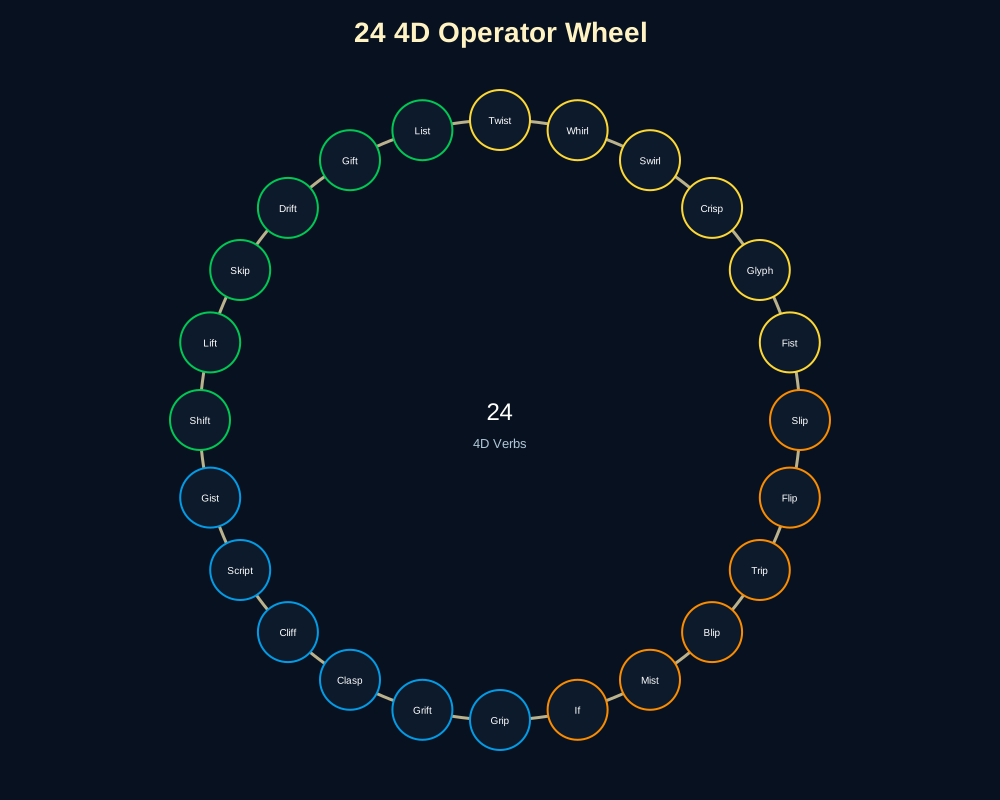
Twenty-four ways a force can move, in four families of six. If the 22 letters are the system’s nouns — what a force is — these are its verbs: what a force does while being itself. Watch each glyph perform its own motion.
A dictionary, not an instrument. Twenty-four named motions are listed with a glyph, a plain-words definition, the seed sound the corpus files each under, and the author's own cause → effect arrow. There is nothing to enter and nothing is computed.
What it computes
- 01Take the 24 modulators from the author's 4D Operator Modulator sheet, in his own wording.
- 02Group them into the four elemental families of six the sheet uses — Fire, Water, Air, Earth.
- 03For each one, print the glyph, the plain-words meaning, the seed syllable and the function arrow.
- 04Animate each glyph in the manner of its family, so the mark performs the verb it names.
How to read it
Read a card as a sentence: the glyph is the shape of the move, the arrow is what it turns into. Lift — ascension → inspiration says a rise in altitude becomes a rise in idea. The shapes are a key of their own: a spiral means twisting, a ring means appearing, a grid means holding. Nothing here applies to a date or a person; it is the vocabulary the reading pages are written in.
What it does not claim
Where the number 24 comes from is an open question inside the corpus itself — the discovery register files this layer as MO-D-014 and marks it inherits Q6 (underived 24), meaning nobody has yet shown that 24 falls out of the system rather than being chosen for it. The resonances offered (24 tesseract edges, 24 hours, 24 musical keys) are noted as suggestive, not as a derivation. And the operator names are the author's coinages, not traditional terms; you will not find Grift or Blip in any older source.
What do the words on this page mean?
Every word on this page
Four terms do all the work here, and none of them mean quite what they mean elsewhere.
this system's word for a force considered as a verb rather than a noun — something the world DOES, not something it is. Each of the 22 Hebrew letters is treated as one.
an operator one layer up. Where a letter-operator names what a force is, a modulator names how it moves while being that force: spinning, sliding, holding, travelling. There are 24 of them and this page is the list.
shorthand for the fact that these describe motion through the system's four-part address — world, element, breath, polarity — rather than motion through ordinary space. Nothing here is a claim about physics.
one of four groups of six. The page groups them by element because that is how they feel; the corpus also groups them functionally, as Torsion, Phase-Shift, Stabilization and Translation.
the single syllable — LAM, VAM, RAM, YAM, HAM, OM, AUM — the corpus files each operator under. They are the traditional chakra seed sounds, one per centre up the spine.
the author's own cause → effect note for the move: what it starts as, and what it becomes. "Lift: ascension → inspiration" is the whole definition compressed to four words.
the mark on the card. The shapes are not decorative — a spiral means twisting, a ring means appearing, a grid means holding — so an operator can be read off its shape before you read its name.
How are the four families named?
The four families, functionally
Alongside the elemental labels this page uses, the names the same four families by what they do:
- Torsion — how a force twists
- Phase-Shift — how a force changes state
- Stabilization — how a force holds its form
- Translation — how a force moves through space
Only one pairing is stated outright in the corpus: Fire = Torsion, seed-sound RAM, seated at the solar plexus. Which of the remaining three functional names belongs to Water, Air and Earth is not written down anywhere in the source material, and this page does not guess — the seed sounds below cut across the elemental groups, so it is not simply one-to-one.
How do I read a glyph by its shape?
Reading a glyph by its shape
The marks are a key, not decoration:
- spirals — torsion — something is being twisted
- sine waves and ovals — phase — something is changing state
- concentric rings — emergence — something is appearing or hiding
- grids — coherence — something is being held in order
- infinity loops — synthesis — two things are becoming one
So an operator can be half-read before you read its name, which is the whole point of giving a motion a mark.
Where do the four elements and the seed sounds come from?
The four families on this page — Fire, Water, Air, Earth — are the oldest sorting system in Western thought. The Greek philosopher Empedocles, around the fifth century BCE, taught that everything is a mixture of four “roots”, and Aristotle later gave each one a pair of qualities (fire is hot and dry, water is cold and wet, and so on). That fourfold habit never left: astrology sorts its twelve signs into four elemental triplicities, alchemy works its materials through elemental stages, and most modern tarot decks map the four suits of the to the same four. Interestingly, the — the source of this site’s letters and gates — uses only three: its are air, water and fire, and earth is famously not given a mother letter of its own.
The seed syllables come from a different tradition entirely. In tantric yoga each of the lower centres carries a one-syllable — LAM at the root for earth, VAM at the sacral for water, RAM at the solar plexus for fire, YAM at the heart for air, HAM at the throat for space. A bija is treated not as a word that means something but as a sound that does something: chanting it is said to wake the element it seeds. When the corpus files Fire under RAM at the solar plexus, it is quoting that traditional assignment exactly.
The idea that a symbol can be a verb rather than a noun also has old roots. Hebrew builds nearly all its words from three-letter action roots, and the Sefer Yetzirah describes the letters themselves as things the Creator “carved, weighed and combined” — tools in motion, not marks on a page. Sanskrit grammarians made the same move, treating seed sounds as compressed acts. A vocabulary of motions attached to a vocabulary of forces is, in that sense, a very traditional thing to build.
What tradition does not supply is the twenty-four motions themselves. The elemental families and the seed syllables are inherited; the named verbs — Lift, Grift, Blip and the rest — are the author’s own coinages, and the corpus itself logs the choice of 24 as an open question rather than a derivation. That line between what is inherited and what is original is drawn on purpose, and the rest of this page tries to keep it visible.
The twenty-four
Each card carries the move, what it means, the it is filed under, and the author’s own arrow from cause to effect.
Fire
ignition · transformationMoves that twist and burn. Fire operators change a thing by working it — spinning it up, sharpening it, forcing it to a point. This is the family the corpus names Torsion, anchored to the seed-sound RAM and the solar-plexus centre.
Wrench a force into a new orientation.
Spin energy up into a vortex.
Blend opposing currents in a spiral.
Sharpen and define by heat.
Imprint a living form as sigil.
Concentrate force to a point of impact.
Water
flow · dissolutionMoves that slide and change state. Water operators get past a thing rather than through it — inverting, branching, thinning out until there is nothing to push against.
Glide past resistance without friction.
Invert polarity smoothly.
Stumble the pattern into change.
A brief pulse in the flow.
Disperse into fine suspension.
Branch the current on a condition.
Air
motion · clarityMoves that travel. Air operators change where a force is rather than what it is — sideways, upward, over a gap, or simply along with whatever is already moving.
Translate position laterally.
Raise to a higher register.
Leap clean over an interval.
Move with the ambient current.
Release force outward, freely.
Lean into ordered sequence.
Earth
structure · gripMoves that hold. Earth operators stop something moving — gripping it, binding two things into one, drawing the edge past which it may not go, or freezing it into a written instruction.
Hold firm against motion.
Divert force by leverage.
Bind two things into one.
Set a hard boundary / edge.
Encode as fixed instruction.
Compress to the essential core.
What do 168 and 5,544 actually count?
In words: two separate tables, both built from the same 24 motions. Each of the 24 motions can happen at any of the seven centres, which gives 168 places a move can land — and 168 is also the number of hours in a week, which the corpus notes as one of its recurring hinges. Separately, each of the 24 motions can be applied to any of the , and 24 × 231 = 5,544, the full field of “this pair of forces, moving this way”. The 168 is not a step on the way to the 5,544 — they are two different pairings. Both are counts of possibilities, not catalogues — nobody has written out 5,544 of anything.
Go further