The Living Wheel
All 72 angels named around the rim, the 36 decans with their tarot minors, the 12 signs, the 22 letters — with the Sun's position now and your own natal Sun
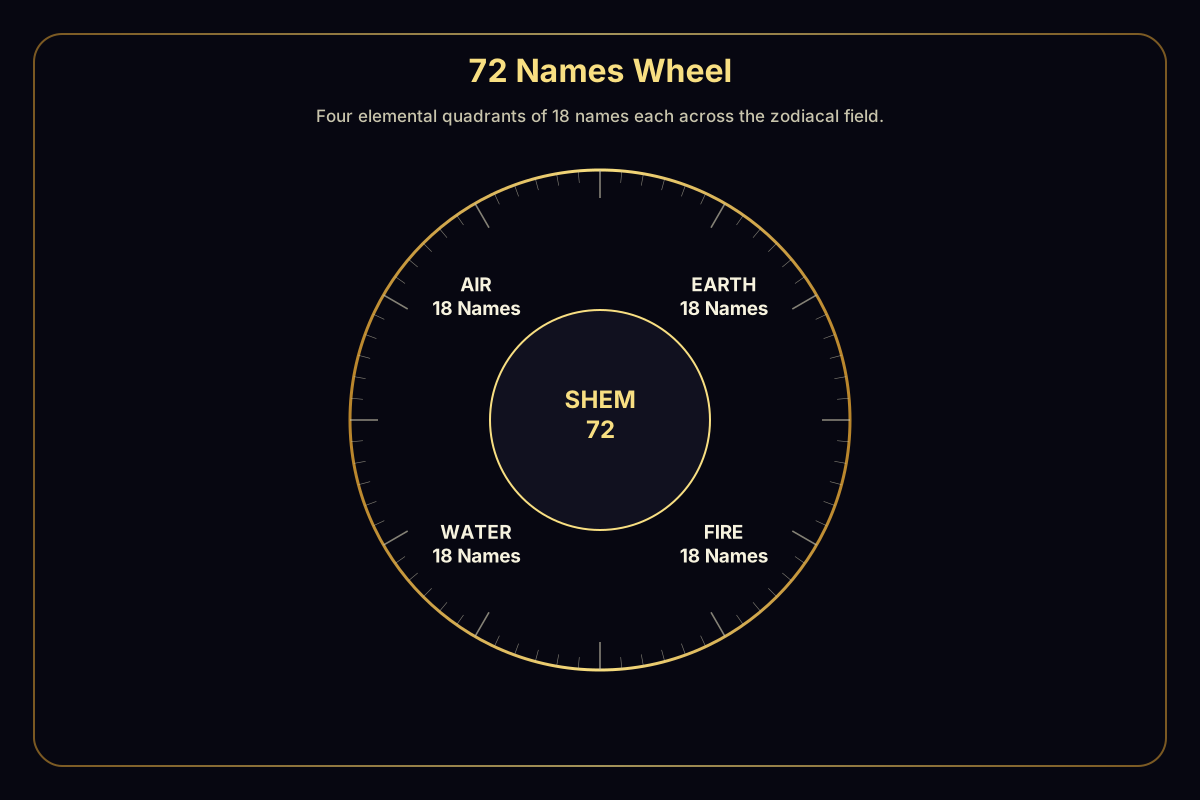
Four traditions, one dial — , , 12 signs and the , all cut from the same 360°. The solid hand is the Sun right now; the dashed hand is your Sun. Click any sector and the centre readout follows.
Before you click anything
Angel 36 · ruling today
Menadel MND-EL
Work & Vocation
Why three letters, and which to trust. Three rules for “the letter of an angel” live on this site, and they mostly disagree. כ Kaf (gold) is the arc you are standing under — the 22 letters cut this same circle into 22 equal 16.36° slices, the way the angels cut it into 72 slices of 5°. נ Nun (violet) is what the angel tables give: walk the alphabet round the 72 sectors, starting over each time it runs out, so angel 36 lands on letter 14 of 22. י Yod (blue) is the Simple letter that rules this angel’s sign — one letter per sign, straight from the Sefer Yetzirah. Across all seventy-two: the first two agree on 3 sectors, the first and third on 4, the second and third on 14, and all three on exactly one — angel 32, Yod. None of them is a bug; they answer three different questions. But if you want the site’s own position: the Degree Engine, which /chart, /clocks and the Free Reading all delegate to, uses the third one and says in its own header that the modular walk is arbitrary, because 72 is not a multiple of 22 and the last six angels get their letters by accident. This dial now prints all three instead of letting one wear the others’ authority.
Decan reading. Legacy and system building — legacy; wealth; family; inheritance; establishment.
Shadow. Workaholism; identity through labor
Click any sector to read it. The gold hand is the Sun now. Enter your birth date on Begin to see your own hand on the wheel. In the innermost ring of letters, gold marks the arc you are standing under and violet marks the letter the angel count gives you.
One dial carrying four traditions at once, all of them derived from the same 360° of ecliptic longitude. The rings nest by resolution: 72 angels at 5° each, 36 decans at 10°, 12 signs at 30°. Because they divide the same circle, they line up exactly — two angels per decan, three decans per sign — and that nesting is arithmetic, not interpretation.
What it computes
- 01The site works out where the Sun sits on the zodiac circle right now — a position from 0° to 360°, where 0° is the start of Aries.
- 02Divide that degree by five and round down, then add one — that is the angel of the moment. The 72 sectors exist because 360 ÷ 5 = 72.
- 03Divide the same degree by ten and you get the decan (36 of them); divide by thirty and you get the sign (12). Each decan carries the tarot minor traditionally assigned to it.
- 04If you have entered a birth date, the site runs the very same calculation for midday (universal time) on that date, placing your natal Sun on the identical dial — that is the second, dashed hand.
- 05The centre readout shows the selected angel with its decan, sign, element and letter. Click any sector to select it and the readout follows instantly.
How to read it
The live hand is where the Sun is now; the dashed hand is where it was when you were born. The angle between them is the part worth attending to — the same angular relationship the tradition reads as a transit. Rings closer to the centre are coarser divisions of the identical circle, so reading inward is reading the same position at lower resolution.
What it does not claim
The Sun’s position comes from a standard published astronomy method (Meeus), accurate to about a hundredth of a degree — so readings near a sector boundary are trustworthy. The letters are the contestable part, and this is the honest size of it: there are three different rules on this site for “the letter of an angel”, and until 4 September 2026 this page ran two of them together without saying so. By position (gold): the 22 letters divide the same 360° into 22 equal arcs of 16.36°, exactly as the angels divide it into 72 arcs of 5°. Pure arithmetic, like every other ring here. By count (violet): the angel tables walk the alphabet round the 72 sectors and start it over whenever it runs out — angel n takes letter n reduced by 22s. Seventy-two is not a multiple of twenty-two (it is 3 × 22 + 6), so the last six sectors restart the alphabet mid-sequence. By the sign’s Simple (blue): the decan table carries a letter of its own — the twelve zodiacal of the , one per sign — and that is the one the Degree Engine uses, the engine that /chart, /clocks and the Free Reading all delegate to. Its own header calls the modular walk arbitrary and refuses it. Counted across all seventy-two sectors, position and count agree on 3, count and Simple on 4, position and Simple on 14, and all three on exactly one — angel 32, Yod. Which should be called the letter of an angel has not been ruled on. All three are printed here so you can see the seam rather than inherit one side of it.
What am I looking at?
The whole correspondence system on a single dial. The outer ring divides the into 72 five-degree sectors — one for each angel of the . Inside it sit the 36 decans, each carrying the traditionally assigned to it, then the 12 signs, then the 22 Hebrew letters. Everything is derived from the same 360°: nothing here is decorative.
Two hands cross the rings. The solid hand is the Sun’s position at this moment — it creeps forward about one degree a day, so the wheel really is alive, just slowly. The dashed hand appears once you have entered a birth date elsewhere on the site and marks your natal Sun on the identical dial. The centre readout shows the live sector until you click a different one; click it again elsewhere and it follows.
Where do the 72 angels and the decans come from?
The — Hebrew for roughly “the explicit name” — began in early rabbinic writing as a way of talking about the unpronounceable name of God. Medieval found a seventy-two-fold version of it hiding in the book of Exodus: the three consecutive verses describing the parting of the sea (Exodus 14:19, 20 and 21) each contain exactly seventy-two Hebrew letters. Read together in a special interleaved order, they yield seventy-two three-letter roots, and each root plus a divine ending — -el or -iah — becomes the name of an angel: Vehuiah, Jeliel, Sitael, and so on around this rim.
Pinning each angel to five degrees of sky is a later move. Because 360 ÷ 72 = 5, the fit was irresistible: occult writers matched the names to the circle’s 5° arcs — the — and nineteenth-century revivals, from the French Kabbalists to , turned that into the tables most modern books reprint. The lineages do not fully agree: some start the count of angels at 0° Aries, others at 0° Leo. This wheel begins at 0° Aries — Vehuiah first, matching the angel pages elsewhere on this site. That layer is inherited tradition and editorial choice, not arithmetic.
The decans are far older than any of that. In ancient Egypt they were thirty-six stars or star groups whose successive risings told the time at night, with a new decan taking over the pre-dawn sky roughly every ten days — cutting the year into thirty-six ten-day stretches. When Egyptian star-lore met Greek astrology, the decans became what they are on this dial: each zodiac sign split into three 10° faces, each with its own character, an idea that then travelled through Indian, Arabic and medieval European astrology for two thousand years.
The tarot is the youngest ring of all. In the late 1800s the Golden Dawn dealt the thirty-six numbered minor cards — the 2 through 10 of each suit — onto the thirty-six decans, one card per face, and that pairing shaped the imagery of the most widely printed tarot deck in the world. So when a decan here “carries” a tarot minor, that is a Victorian correspondence resting on a Hellenistic division resting on Egyptian timekeeping. What is exact on this page is the nesting arithmetic — two angels per decan, three decans per sign. What is tradition is every name and character attached to the arcs, and this site presents those as inherited convention, not measurement.
How the 72 names are actually built
Write out Exodus 14:19 letter by letter. Beneath it write 14:20 in reverse order, and beneath that 14:21 forwards again — a back-and-forth pattern like plowing a field. Now read the columns: each column of three letters, taken top to bottom, is one root. Do that for all seventy-two columns and you have the full set.
Each root then takes one of two endings drawn from divine names — -el or -iah — to make a pronounceable angel name. Which root takes which ending, and how the Hebrew is rendered into Latin letters, varies from source to source, which is why the same angel can appear as Vehuiah, Vehuyah or Vehujah depending on the book in your hands. The names on this rim use the same as the rest of this site, so an angel here matches its entry on the angel pages.
Go further