The 12 Cosmic Ages
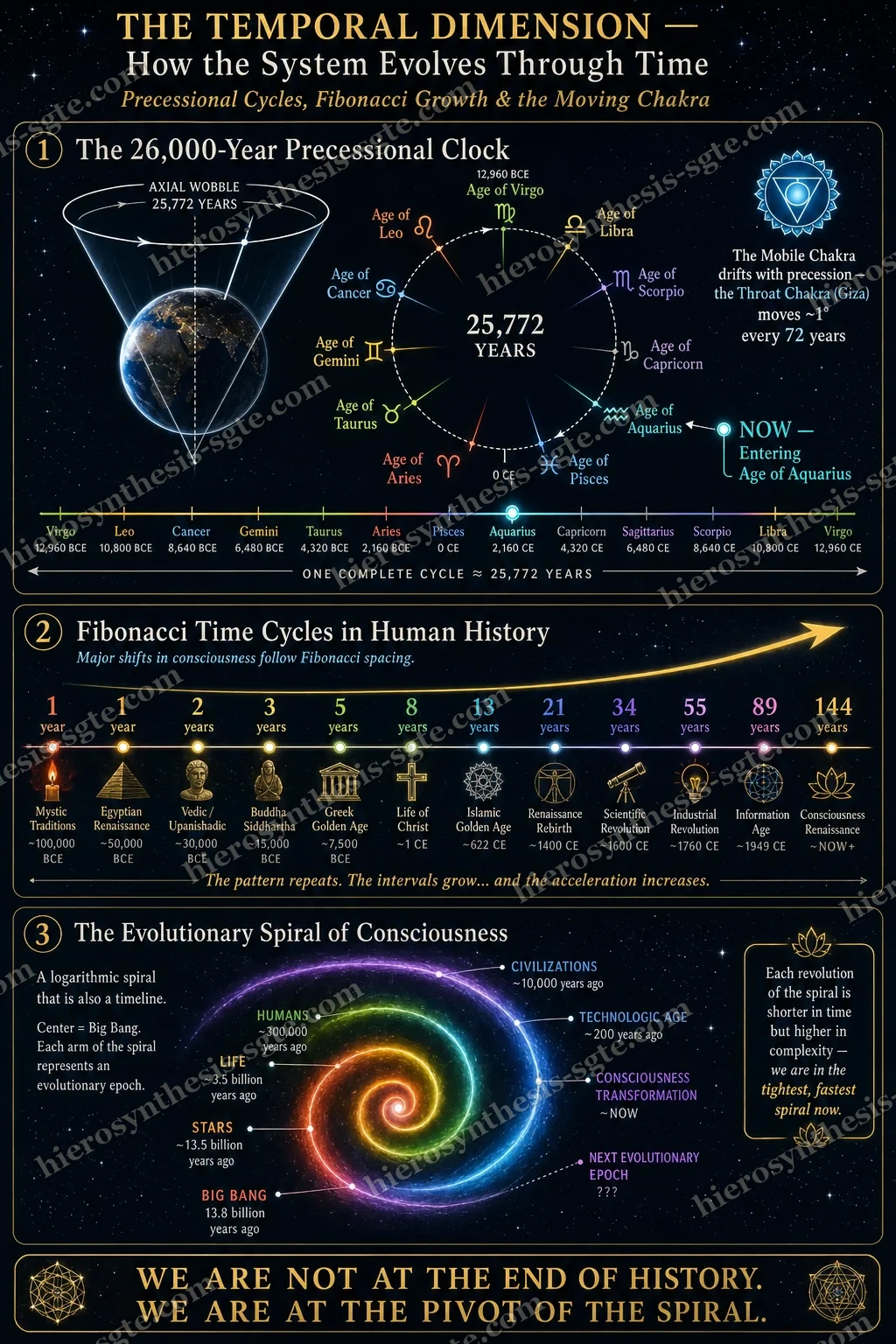
The Earth's axis wobbles once every twenty-six thousand years. Cut that wobble into twelve and you get these — the Age of Taurus, the Age of Pisces, the Age of Aquarius we are standing in now.
A reference table, not an instrument — it computes nothing about you. The twelve ages are the author's own reading of the Great Year: one complete wobble of the Earth's axis, cut into twelve stretches of roughly 2,160 years, each named for the constellation standing behind the sun at the spring equinox during it. The only live thing on the page is which age contains today.
What it computes
- 01The wobble is real. The Earth's axis traces a slow cone, one turn in about 25,772 years. It is why the pole star changes over millennia and why the spring equinox has drifted out of Aries and across Pisces since antiquity.
- 02The twelve. This site uses the round classical Great Year of 25,920 years, which divides by twelve to give ages of exactly 2,160 years.
- 03The order runs backwards. Precession drags the equinox point against the usual order of the signs, so the ages go Taurus → Aries → Pisces → Aquarius, not forwards.
- 04Today's age is found by comparing the current calendar year against the twelve era boundaries in the table and returning the one that contains it.
- 05Everything else on a card — sephirah, frequency, letter, world, trait, and the description — is read straight from the author's own record for that age. Nothing is derived.
How to read it
Read an age as a claim about the character of a long stretch of history, held up against the sky as its clock. The astronomy — that the equinox drifts, and how fast — is measured and checkable. Everything laid on top of it (that the first six ages descend and the second six ascend, that the Age of Taurus was about earth-temples, that an age has a frequency) is an interpretation. The two are deliberately kept in separate columns below so you can accept one without the other.
What it does not claim
Nobody agrees where an age starts. There is no astronomical boundary to find: the constellations are unequal in width, the IAU boundaries that fix them were drawn in 1930 for cataloguing purposes, and the '30° sign' the equinox is measured against is a different object from the constellation of the same name. Published estimates for the start of the Aquarian age span more than a thousand years. The 2012 boundary used here is the author's, not a finding, and the page names it as such. Nothing here forecasts anything.
The twelve, in order
Reading left to right and top to bottom is reading forwards in time — which, because runs backwards, means reading backwards through the zodiac. Gold cards descend into matter; green cards climb back out. Tap any card for its full record.
The deep drawers
Everything the cards do not say out loud lives below — where the dates come from, what every label means, where the whole idea of “ages” came from, and the two places this table argues with the rest of the site.
Where do these dates come from?
The site's era boundaries are not rounded guesses. They come out of one division, and it is worth seeing the sum done, including the one place it is fudged.
The one place the ladder is hand-pinned
Why nobody can tell you the 'real' date
The Great Year in six lines
The same primer the Cosmic Clock uses, so the two pages cannot drift apart.
Precession — the Earth's axis wobbles like a slowing spinning top. One full wobble takes roughly 25,800 years, and it drags the whole sky slowly backwards behind the calendar.
The Great Year — one complete wobble. This site uses the round classical figure of 25,920 years, which divides neatly by twelve; the measured figure is about 25,772.
A zodiacal age — one twelfth of the Great Year — about 2,160 years — named for the constellation that sits behind the sun at the spring equinox during it.
Why the ages run backwards — because precession moves the equinox point backwards through the constellations. That is why the order here is Taurus, then Aries, then Pisces, then Aquarius, rather than the forwards order a birth chart uses.
Descend / ascend — the site's own reading of the wheel: the first six ages are read as spirit settling into matter, the second six as matter waking back up. It is an interpretation laid over the arithmetic, not a feature of the sky.
Era — the years the site assigns to that age. These are the site's boundaries — see the note on the page about where they come from and how much they are disputed.
What does every word on a card mean?
Six labels appear on every age's record, plus its era, theme and arc. Here is what each one is, and how much weight it will bear.
Element — which of the four elements the sign of that age belongs to — Fire, Earth, Air or Water. It is the ordinary astrological grouping, not a claim about matter.
Sephirah — which station on the Tree of Life the age is filed under. Twelve ages are being laid onto ten stations, so four of them are used twice and two — Keter and Malkuth — are never used at all.
Frequency — the tone the site assigns to that sephirah, in hertz. It is not the age's own number: every age filed under Hod reads 264 Hz, every age under Binah reads 444 Hz. Nothing has been measured; it is a label, in the same way a colour is a label.
Letter — the Hebrew letter the site pairs with that sign. Eleven of the twelve follow the standard Sefer Yetzirah attribution; the twelfth does not, and the page says which.
World — which of the four Kabbalistic worlds the age is read into — Atziluth (emanation), Briah (creation), Yetzirah (formation), Assiah (action). The scheme here uses three of the four.
Trait — a two-word portrait of the age's character, in the author's own words.
Theme — the one-line title the author gives the age — what he takes it to have been for.
Arc — whether the age is read as part of the descent into matter (the first six) or the climb back out of it (the second six).
Era — the years the site assigns to that age. See the arithmetic below for exactly where these boundaries come from.
Where does the idea of the ages come from?
The wobble itself was noticed long before anyone owned a telescope. Around 130 BCE the Greek astronomer Hipparchus compared his own measurements of the star Spica against records made about a century and a half earlier and found the whole sky had shifted by the same small amount — the grid itself was creeping. Isaac Newton later supplied the cause: the sun and moon tugging on the Earth's equatorial bulge, turning the axis the way a slowing top turns. It is why the pole star is a temporary appointment — when the great pyramids were built the north pole pointed near Thuban in the constellation Draco, today it points at Polaris, and in about twelve thousand years it will point at Vega.
The idea that history comes in great ages is far older than the idea that the zodiac keeps time for them. Hesiod, writing around 700 BCE, told of races of gold, silver, bronze and heroes declining into his own age of iron; Hindu tradition counts the , vast repeating world-ages ending in the present Kali Yuga; other cultures kept long cyclical calendars of their own. What those share with this page is the shape — history as a wheel rather than a line, with each turn of the wheel carrying its own character.
Marrying that old idea to precession is mostly a modern move. The zodiacal ages as commonly told — each stretch of roughly 2,160 years stamped with the character of its sign — took shape in the nineteenth century among Theosophical and esoteric writers, and got their most serious airing in the twentieth, when the psychologist Carl Jung read the Christian era as the Age of Pisces (the fish was one of the earliest Christian symbols) and asked in print what the turn toward Aquarius might mean. The phrase went fully mainstream in the late 1960s, carried by the counterculture and a hit musical. So the clock is ancient astronomy, but the popular reading of the clock is younger than the telegraph — worth knowing, and no scandal: every tradition starts somewhere.
What this site adds on top is its own synthesis: filing each age under a station of the , a Hebrew letter, one of the and a tone. The sign-to-letter pairings mostly follow the , whose attributions are themselves centuries old; the descent-and-ascent arc, the themes and the 2012 boundary are the author's own reading, and the page labels them as such. That is the honest place to leave it: the wobble is measured, the twelve-fold cut is a convention, and everything with a character in it is interpretation.
Does this table agree with the rest of the site?
Not quite — two disagreements, found while writing this page. Both are the author's call to settle; neither has been changed.
Eleven of the twelve ages carry the letter the site's own letter table gives their sign — Cancer/Chet, Gemini/Zayin, Taurus/Vav, and so on down the list. The Age of Leo carries Kaf, which that table calls a ruled by Jupiter. Leo's own letter there is Tet. One of the two entries is a slip, and the page cannot tell which — so it prints what the data says and flags it here.
This table writes Heth, Kaph, Samech, Tzadi and Qoph; the letter table writes Chet, Kaf, Samekh, Tzaddi and Qof. Search either page for the other's spelling and you get nothing. The letter chips in each age's record now link through to the canonical spelling so the trail does not break, but the underlying data still disagrees with itself.
Go further