The Clock Stack
What time is it, in every system at once — from the 20-minute soul sector to the Fibonacci life-arc
Which time page is which?
The site has more than one clock and their names are nearly identical, so here is the difference in one line each.
- The Clock Stack (this page) — every cycle at once, eleven of them, sorted fastest to slowest, each with a progress bar and a countdown to its next turnover. Come here to see the whole ladder.
- The Cosmic Clock — three cycles read in depth rather than eleven read in brief: the tattva wheel that turns every minute, the five-degree solar window that turns every five days, and the precessional age that turns every two thousand years. Come here to understand one cycle properly.
- The Daily Current — not a clock at all but today’s reading: what the current positions actually say, in sentences.
The moon is the same moon on all of them — every page on the site now reads one shared lunar table, so no two pages can name different phases on the same evening.
Four of these clocks share one currency — . The solar and calendar clocks are two methods for the same ≈5-day cycle, so their agreement is the expected case — most days they match. What is rare by construction is a cross-speed match, and that is the only thing the convergence strip flags.
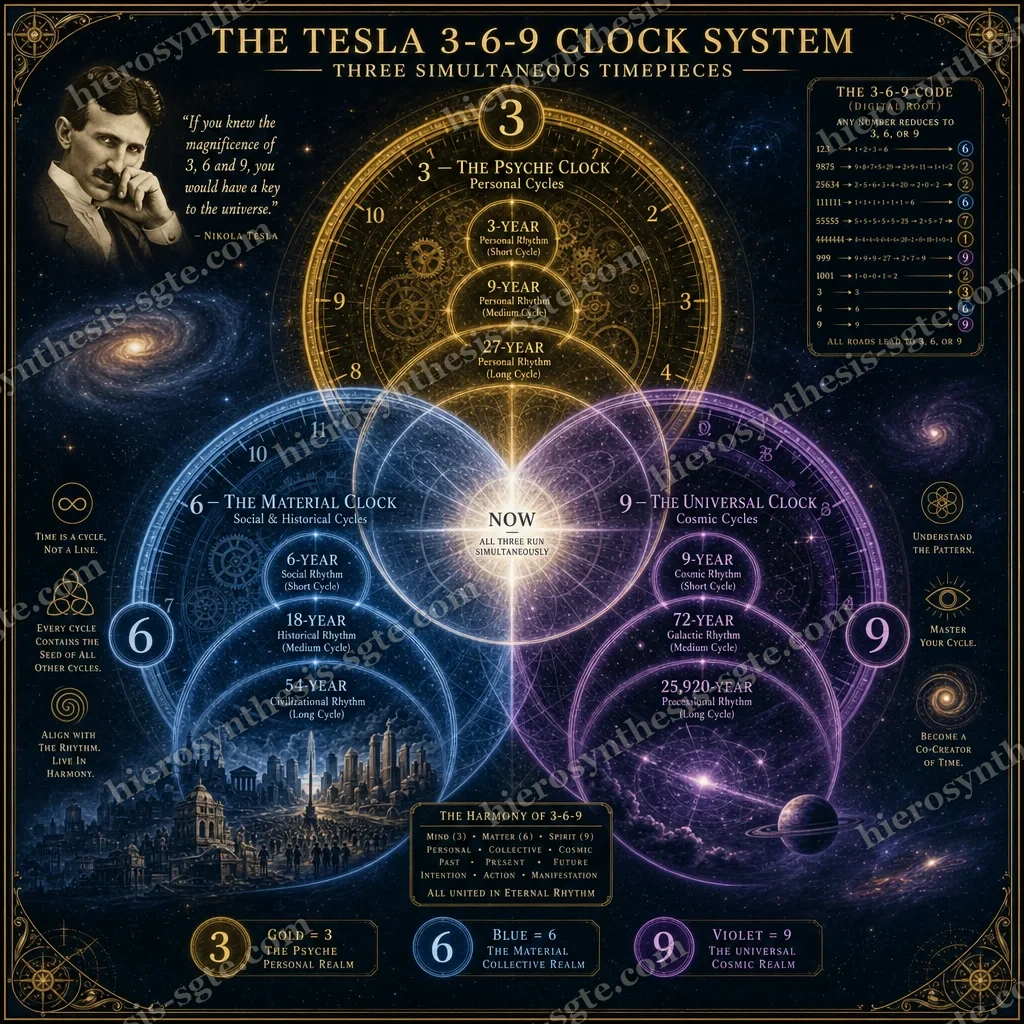
Where do these clocks come from?
Layering several clocks on top of each other is one of the oldest habits in sacred timekeeping. The astrologers of Babylon and Egypt never used just one: the zodiac wheel was cut into twelve signs, then into thirty-six of ten degrees each — originally Egyptian star-groups whose risings marked the hours of the night — and each hour of the day was handed to a planet in turn, cycling through the as a . So the idea behind this page — many cycles of very different speeds all running at once, each with its own ruler — is thousands of years old. The Clock Stack simply runs them side by side and lets you watch the hands move.
The angel clocks have a specific pedigree. tradition finds the 72 names in three consecutive verses of Exodus (14:19–21), each of which contains exactly seventy-two Hebrew letters: read the three verses in alternating directions, stack them, and each column spells a three-letter name — the . Later tradition gave those names rulership over time at several speeds. Each angel was assigned a — one five-degree slice of the 360-degree wheel, which the Sun crosses in about five days (72 × 5° = 360°) — and, in the French occult manuals of the 1800s, each angel also received a twenty-minute portion of the day (72 × 20 minutes = 24 hours). A third rotation from those same manuals gives each day its own angel, all seventy-two in turn, in a 72-day round traditionally restarted near the spring equinox. Those three rulerships are exactly the solar and calendar clocks, the soul sector, and the heart cycle above.
The number clocks come from a different stream. The personal day, month and year are modern , popularized in its current form in the early twentieth century: add your birth month and day to the current date and reduce the total with the . The nine-year cycle is that same arithmetic stretched across years. The moon's 29.53 days is the — new moon to new moon — very likely the first calendar humanity ever kept. The arc is the one clock here that comes from no older manual: reading a life along the Fibonacci ages is this synthesis's own instrument, and the Life Spiral page tells that story in full.
An honest note on what all this is. The cycle lengths are checkable arithmetic: the Sun really does cross a five-degree window in about five days, the moon really does return to new in 29.53 days, and when two clocks running at genuinely different speeds name the same angel at the same moment, that coincidence is real and genuinely rare. What tradition adds — that a slice of time has a quality, a flavor, a ruler — is interpretation, and this site presents it as interpretation. The clocks tell you where each cycle stands; what a convergence means is left to you.
Where each hand on the stack goes next