✶ Angel Engine — Multi-Method Reader
There are in this tradition, one for every five degrees of the zodiac. Which one is yours depends entirely on how you ask — and there are five established ways of asking. This engine runs all five at once and shows you where they agree and where they do not. Your details are saved only in this browser, so you enter them once — nothing is ever sent anywhere.
A five-method reader for the 72 . Give it a birth date (and, if you have them, a time and time zone) and it computes which angel governs that moment under five different conventions, laid side by side rather than blended into one answer.
What it computes
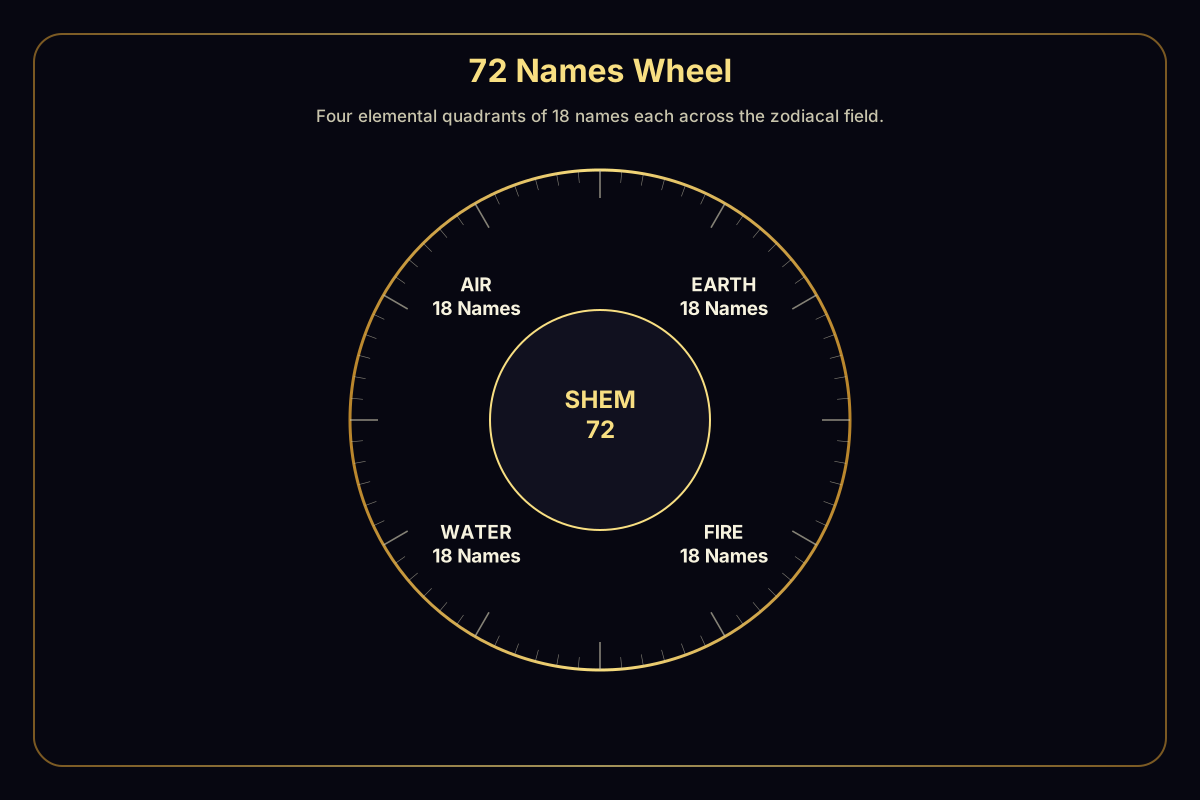
- 01Divide the 360° zodiac into 72 slices of 5°. One angel per slice — that division is exact arithmetic.
- 02Traditional Guardian — match the civil birth date to each angel's published five-day window; separately run a day-by-day count from March 21 that wraps every 72 days; separately find the 20-minute slot of the birth time. Three angels: body, heart, mind.
- 03Natal Planetary — compute where the Sun, Moon and Mercury actually stood, and name the angel owning each of those degrees. Three angels: identity, feeling, thought.
- 04Fixed 360-Day Wheel — step five clean days at a time from March 21 and read off where the birthday lands. A year is 365 days and the wheel is 360, so the last five days of the cycle have nowhere to go and are folded onto the 72nd angel with the five before them — the one seam in an otherwise even division, and it is described rather than hidden.
- 05Workbook Solar — the same wheel, offset by one day, matching the author's own spreadsheet rows. It inherits the same 72nd-angel seam.
- 06Exact Solar — compute the Sun's true apparent longitude for the date, time and UTC offset, and name the angel who owns that degree. The most astronomically grounded of the five, and the one the rest of the site prints when it has to name just one.
- 07Print all five. Do not reconcile them — the disagreements are the reading.
How to read it
Five methods, and they will not always agree. That is the point, and it is not an error: each one is answering a different question about what 'your angel' means — the calendar's answer, the sky's answer, the wheel's answer. Where several land on the same angel, that agreement is worth something. Where they scatter, read them as different rooms of the same house rather than as four wrong answers and one right one.
What it does not claim
The 72 × 5 = 360 arithmetic is exact. The ephemeris is approximate — compact Meeus-style formulae, good to a fraction of a degree, fine for symbolic work and not a substitute for a professional ephemeris. And the angels' published calendar dates are a traditional convention flagged tier C (unverified) pending a canonical source, which is exactly why five methods can disagree in the first place.
your birth details, five methods at once
Birth date is enough to run three of the five methods. Adding a time and UTC offset unlocks the other two — the Moon moves about half a degree an hour, so without a time the Moon's angel is a guess.
Hours from UTC where you were born. New York is −5, London 0, Sydney +10.
What you enter here is saved only in this browser, never uploaded — the calculation runs locally, and nothing is ever sent anywhere. These same three fields are shared with every other instrument on the site, so you enter them once; the Forget button on the Begin Here page erases them.
Every word on an angel card
Where do 72 angels come from?
From three verses of Exodus. Chapter 14, verses 19, 20 and 21 each contain exactly seventy-two Hebrew letters. Write the first verse forwards, the second backwards and the third forwards, stack them, and read down the columns: you get seventy-two three-letter groups. Add the divine ending -IAH or -EL to each and you have seventy-two names. That construction is called the , the “explicit Name”.
The number then lands on the circle without being forced: 360° ÷ 72 = exactly 5°. The circle takes seventy-two five-degree wedges with nothing left over, so each name gets one slice of sky. That arithmetic is exact — it is tier A. Which name goes in which slice, and which calendar dates the slices correspond to, is traditional attribution and sits several tiers down.
How did these names travel through history?
The names are old; the birthday system is not — and telling those two layers apart is most of understanding this page. The oldest layer is Jewish. Medieval commentators, Rashi among them, speak of a divine name of seventy-two parts drawn from those three Exodus verses, and the names appear spelled out in medieval manuscripts. In that world they were names of God — recited for protection and contemplation — not a system for looking anyone up by birth date.
In the Renaissance the names crossed into Latin Europe, carried by Christian scholars who had taken up Kabbalah second-hand. By the 1650s the Jesuit polymath Athanasius Kircher had printed a great wheel of all seventy-two names arranged around a circle — a recognisable ancestor of the Shem Wheel tab above. Later still, the folded the angels into its own machinery, seating two of them on each of the thirty-six , which is how each angel came to carry a tarot card at all.
The layer most visitors assume is ancient is actually the newest. The scheme that hands each angel a five-day stretch of the calendar and names one of them your birth guardian comes chiefly from nineteenth-century French occultism — Lenain's La Science Cabalistique of 1823 is the table most later books trace back to — and the three-guardian reading this page computes (body by date, heart by a seventy-two-day count, mind by a twenty-minute slot) was elaborated by twentieth-century writers in that same French and Spanish lineage.
That history is why this engine behaves the way it does. The arithmetic — 72 × 5° = 360° — is as old as the names and exact forever. The calendar tables are barely two centuries old, and different published versions disagree by a day or so, which is why the dates are flagged tier C here and why five methods run side by side instead of one of them pretending the question is settled.
Which answer should I actually use?
If you want one angel and no arguing: take Exact Solar. It is the only one of the five that asks where the Sun really was rather than what a table says, and it is what the rest of the site prints when it has to name a single guardian.
If you want the traditional reading: take the three Traditional Guardian angels — body, heart and mind — and treat them as three aspects rather than three candidates. That is how the older sources use them.
And if two methods happen to land on the same angel for you, that is the one worth sitting with. Agreement across independent conventions is the only evidence this page can offer, and it offers it honestly rather than hiding the times it does not appear.
The disagreement is the instrument
Go further