☯ I Ching — Book of Changes
The full 64-hexagram King Wen sequence, a traditional three-coin casting simulator, and today’s hexagram of the day. A parallel oracle layer alongside Tarot, Gates, and Angels — same method, different vocabulary.
If you have never seen one of these: a hexagram is a stack of six horizontal lines. Each line is either whole or split down the middle, so six of them give sixty-four possible figures — and the I Ching, which is about three thousand years old, is simply those sixty-four figures with a paragraph attached to each. You either ask it a question and let chance pick one, or you read the one belonging to the day. Everything below names its own parts as it goes.
The oldest divination system still in daily use, rendered whole. Six lines, each of two kinds, give 64 figures; each figure carries a Judgment and an Image handed down in the same words for millennia. This page will cast one for you at random, hand you the one that belongs to today, or let you read all sixty-four.
What it computes
- 01Casting simulates the traditional three-coin throw. Three coins, heads counting 3 and tails 2, are thrown once per line — six throws, bottom line first. The sum can only be 6, 7, 8 or 9.
- 027 and 8 are ordinary lines: 7 is a solid yang line, 8 a broken yin one. 6 and 9 are the extremes — a yin so full it is becoming yang, and a yang so full it is becoming yin. Those are the changing lines, drawn in gold.
- 03The six lines are read as two trigrams, lower and upper, and looked up in the King Wen table to give your hexagram.
- 04If any line was changing, it is flipped and the table is consulted again. That second figure is the relating hexagram — where the situation is heading.
- 05Hexagram of the day does no throwing at all: it counts the day of the year around the circle of 64, so it is the same figure for every visitor today and it changes at midnight.
How to read it
Read the Judgment first and do not try to solve it — it is a description of a situation, not an instruction. Then read the Image, which is the part that suggests conduct. If you cast and got changing lines, the first figure is now and the relating figure is next; the gap between them is usually the actual answer. A hexagram that reads badly is not a prediction of harm, it is a description of a shape.
What it does not claim
This is a symbolic tradition, not a measurement of the world. The coin throws are your browser's random-number generator, which is chance and nothing more — the page makes no claim that anything guides it. The hexagram of the day is arithmetic on the calendar, not astronomy. Nothing here is medical, psychological, financial or legal advice.
Every word on a hexagram card
Nine terms, and then nothing on this page is unexplained.
- Line
- — one horizontal stroke. It is either unbroken — yang, active, asserting — or split in two, which is yin: receptive, yielding. Neither is the good one.
- Hexagram
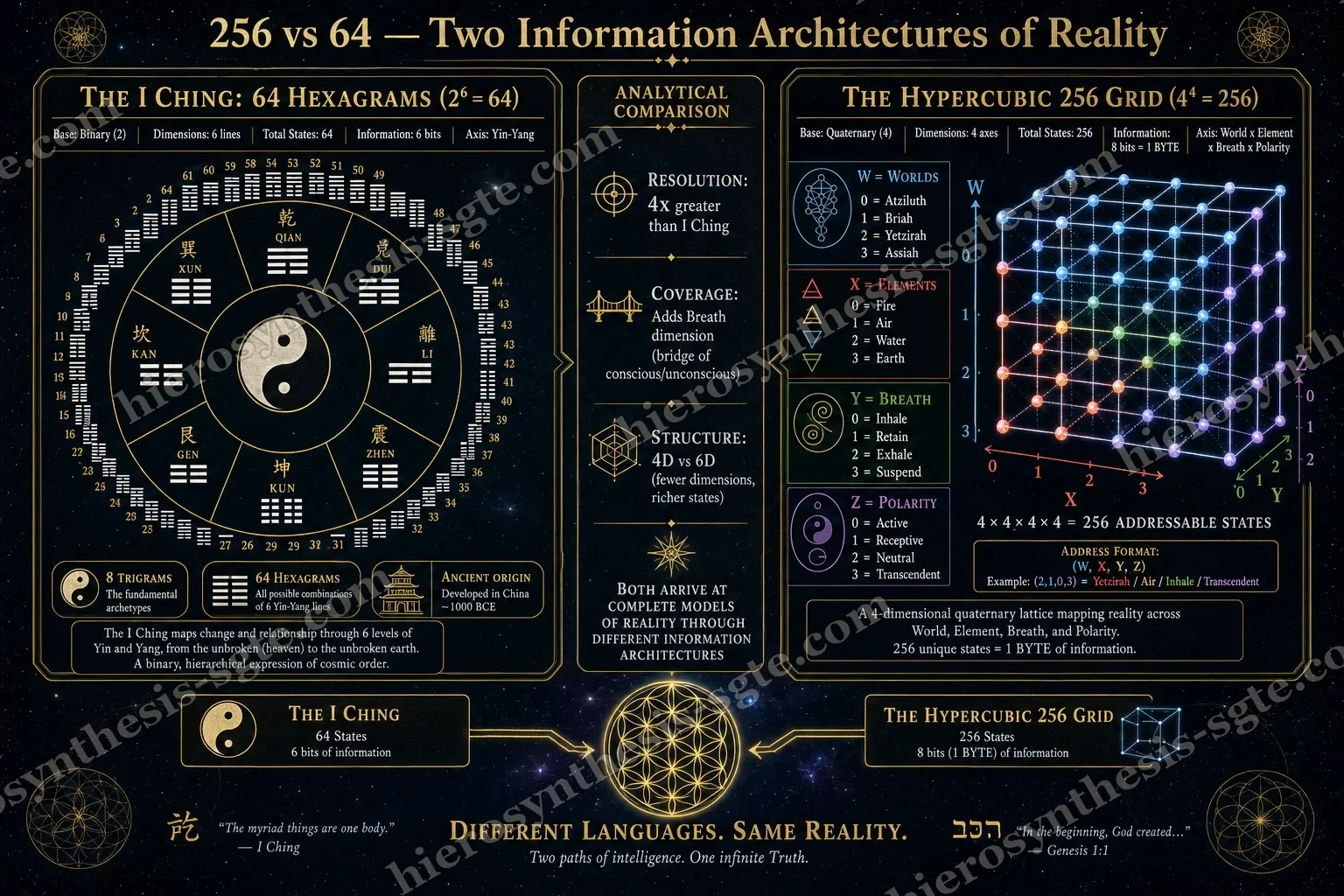
- — an I Ching figure of six stacked lines, each solid (yang) or broken (yin). Two choices, six places: 2⁶ = 64 figures. That is the whole book — there is no sixty-fifth.
- Read from the bottom
- — the first line thrown is the lowest one, and the figure builds upward. The bottom is the beginning of the situation, the top is its outcome.
- Trigram
- — the figure splits in half: three lines below, three above. Each half is one of eight trigrams, and each trigram is a picture — heaven, earth, thunder, water, mountain, wind, fire, lake. 8 × 8 = 64.
- King Wen order
- — the traditional numbering of the 64 hexagrams, from 1 The Creative to 64 Before Completion. It is roughly three thousand years old and is not sorted by anything obvious; it is the order this page uses.
- Judgment
- — the short verdict attached to the hexagram by tradition — the sentence you are meant to sit with rather than solve.
- Image
- — the picture behind the figure, and the conduct it recommends. Where the Judgment says what the situation is, the Image says what to do inside it.
- Changing line
- — a line thrown in its extreme form is already turning into its opposite. Flip every changing line and you get a second hexagram — the relating one.
- Relating hexagram
- — where the situation is heading, given the lines that are already moving. If nothing is changing, there is no second figure and the answer is simply standing still.
Ask something you actually want an answer to, then throw. Chance picks the figure; you do the reading.
Where the 64 meets the rest of the system