The Universal Cosmogram
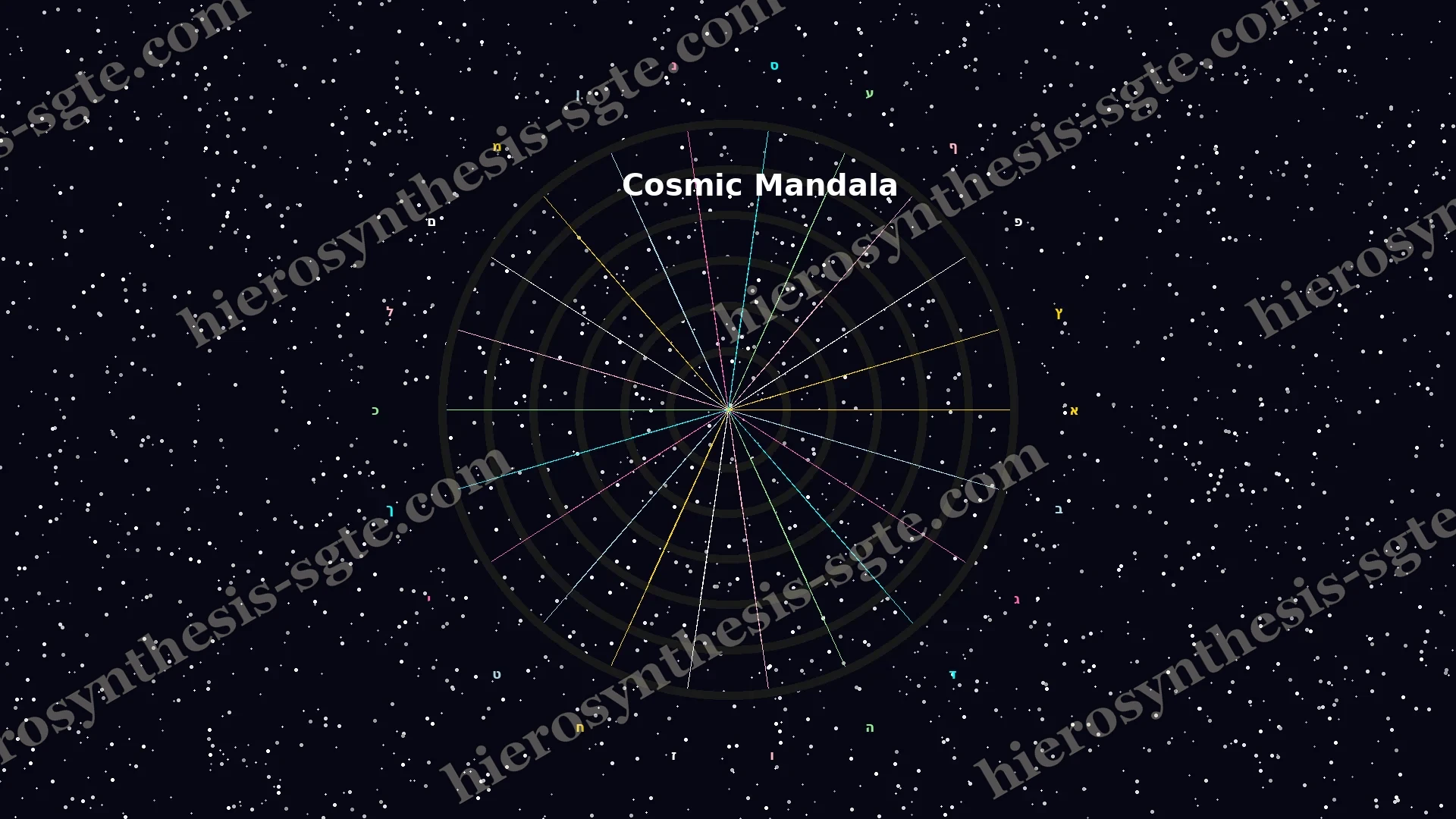
All twenty-two Hebrew letters on one wheel. Not an alphabet for writing — an alphabet of forces, each one a thing the world does. Tap a spoke to read what its letter is for.
A map, not a calculator. Every letter in the system laid out as one wheel so you can see the whole alphabet of forces at once and how the three families are scattered through it. Tapping a spoke opens that letter's full record — its element, its number, what it does, and the author's own paragraph on it.
What it computes
- 01The twenty-two letters are placed evenly around the circle in their traditional order, Aleph at the top and running clockwise to Tav.
- 02Each spoke is coloured by the letter's element — Air, Fire, Water or Earth. Mother letters carry an element outright; the others inherit one.
- 03The small tick outside each node marks the letter's class: gold for the 3 Mothers, violet for the 7 Doubles, slate for the 12 Simples. 3 + 7 + 12 = 22.
- 04Selecting a letter reads its record straight out of the site's letter table. Nothing is computed, blended or generated.
How to read it
Read the wheel for shape, not for prediction. The useful thing it shows is that the three families are not blocks — the seven Doubles are scattered right around the circle rather than sitting together — and that the four elements are distributed unevenly. Read a single letter as a verb: what does this force do when it is switched on. Two letters together make a gate, which is what the 231 Gates page is for.
What it does not claim
The wheel asserts nothing about the sky, the body, or the future. The letter-to-element and letter-to-planet attributions come from the Sefer Yetzirah and are ancient but not unanimous — manuscripts differ. The tarot column is a nineteenth-century overlay, not part of the original text. The circle's rings and its centre glyph are ornament: they carry no data, and the legend says so rather than letting you wonder.
Tap any letter — or tab to it and press Enter — to read its force.
What do the colours, ticks and rings mean?
Air — breath, movement, mind — what passes between things.
Fire — heat, will, drive — what changes things.
Water — feeling, depth, flow — what receives and dissolves.
Earth — weight, form, holding — what settles and lasts.
3 Mothers — the three root letters — Aleph, Mem and Shin — standing for Air, Water and Fire. Everything else is read as a combination of these.
7 Doubles — seven letters that each carry a thing and its opposite (life/death, peace/war, wealth/poverty). Each governs one of the seven classical planets and one day of the week.
12 Simples — twelve letters, one for each sign of the zodiac and each month of the year. The ordinary working letters of the wheel.
The three faint rings and the centre glyph — ornament. They carry no data. The centre reads א∞: Aleph, the letter of the silent breath, standing for the unbounded thing the wheel turns around.
The arranges the as the spokes of one wheel — the , and the says creation is built from. In this system each letter is a verb rather than a shape: a thing the world does. Select one to read what it does, what it is worth as a number, and the author's own paragraph on it.
Nothing on this page is personal and nothing is stored. It is the same wheel for everyone.
Where do 22 · 231 · 10 · 256 come from?
Four figures recur all over this site — . None of them is an opinion; each one is a count, and here is the counting.
letters — 3 Mothers + 7 Doubles + 12 Simples. The whole Hebrew alphabet.
gates — every pair of two different letters: 22 × 21 ÷ 2. Halved because Aleph-with-Bet and Bet-with-Aleph are one meeting, not two.
sefirot — the ten stations of the Tree of Life — the levels the letters move between.
states — 4⁴ — four elements taken in four positions. A second, authored route reaches the same figure: 231 gates + 22 letters + 3 more. The author's records name that 3 two ways — the three Mothers (his Manifestation Identity) and the three transcendent states, Ain, Ain Soph and Ain Soph Aur, that circuit 9 counts as states 254–256. The namings differ, and this site keeps both in view rather than quietly picking one.
All four are arithmetic — they follow from the counts, not from an interpretation. The one exception is the second route to 256, which is the author's identity rather than a count; the Nine Circuits page shows the accounting that ends in the three transcendent states. What the numbers are taken to mean is a separate question, and a softer one.
Where does a wheel like this come from?
A is a picture of the whole cosmos drawn small enough to take in at one look. People have made them in most times and places: the sand mandalas of Tibet, the medieval European diagrams of nested heavens with the Earth at the centre, the Kongo cosmogram traced on the ground as a cross inside a circle. The instinct behind all of them is the same — if the world has a shape, you should be able to draw it — and the shape chosen is nearly always a circle, because a circle has no beginning, no end, and no privileged side.
The particular wheel on this page is older than it looks. It comes out of the Sefer Yetzirah, the “Book of Formation” — a Hebrew text only a few pages long whose date nobody has settled; scholarly estimates run from roughly the second century CE to the seventh. That text is where the sorting of the alphabet into 3 Mothers, 7 Doubles and 12 Simples comes from, and it does not merely list the letters: it describes them as set in a circle, like a wall with 231 gates, with the circle turning forwards and backwards. Drawing the alphabet as a wheel is not a modern design decision — it is what the source text itself describes, and medieval manuscript copies and commentaries really do include circular letter-diagrams.
Hold the attributions with the right grip. The 3–7–12 division, the Doubles paired with the seven classical planets, the Simples paired with the twelve zodiac signs — all of that is in the text. But which Double gets which planet differs between the surviving manuscript families, so there is no single original assignment to recover; the tradition genuinely carries several. This site uses one scheme consistently so its pages agree with each other, which is a choice among traditions, not a discovery.
The Tarot line in the letter panel is the youngest layer by far. In the mid-1800s the French occultist matched the twenty-two trumps of the to the twenty-two letters; the in England later shifted his mapping by one place — starting the count from the Fool instead of the Magician — and their version became standard in the English-speaking world. It is a genuinely useful overlay, since each trump works as a picture of its letter's idea. But it is a nineteenth-century reading laid over an ancient wheel, and this site labels it that way instead of presenting it as part of the original text.
Why an alphabet, of all things?
Why an alphabet, of all things
What do I do with a letter once I have one?
What to do with a letter once you have one
Go further