ה Name Decoder
Type a name and it is taken apart twice: once by the Western letter-to-number wheel, once by the and their values. Four figures come out, and each one is explained where it appears.
Looking for your saved details? This is a calculator, not an account.
This page saves nothing, not even the name you type, and it forgets everything the moment you close the tab. The birth details the rest of the site reuses live in your own browser’s storage on this device only, never on a server. You can see, change or erase them at Begin Here — the “forget me” button there wipes them for good.
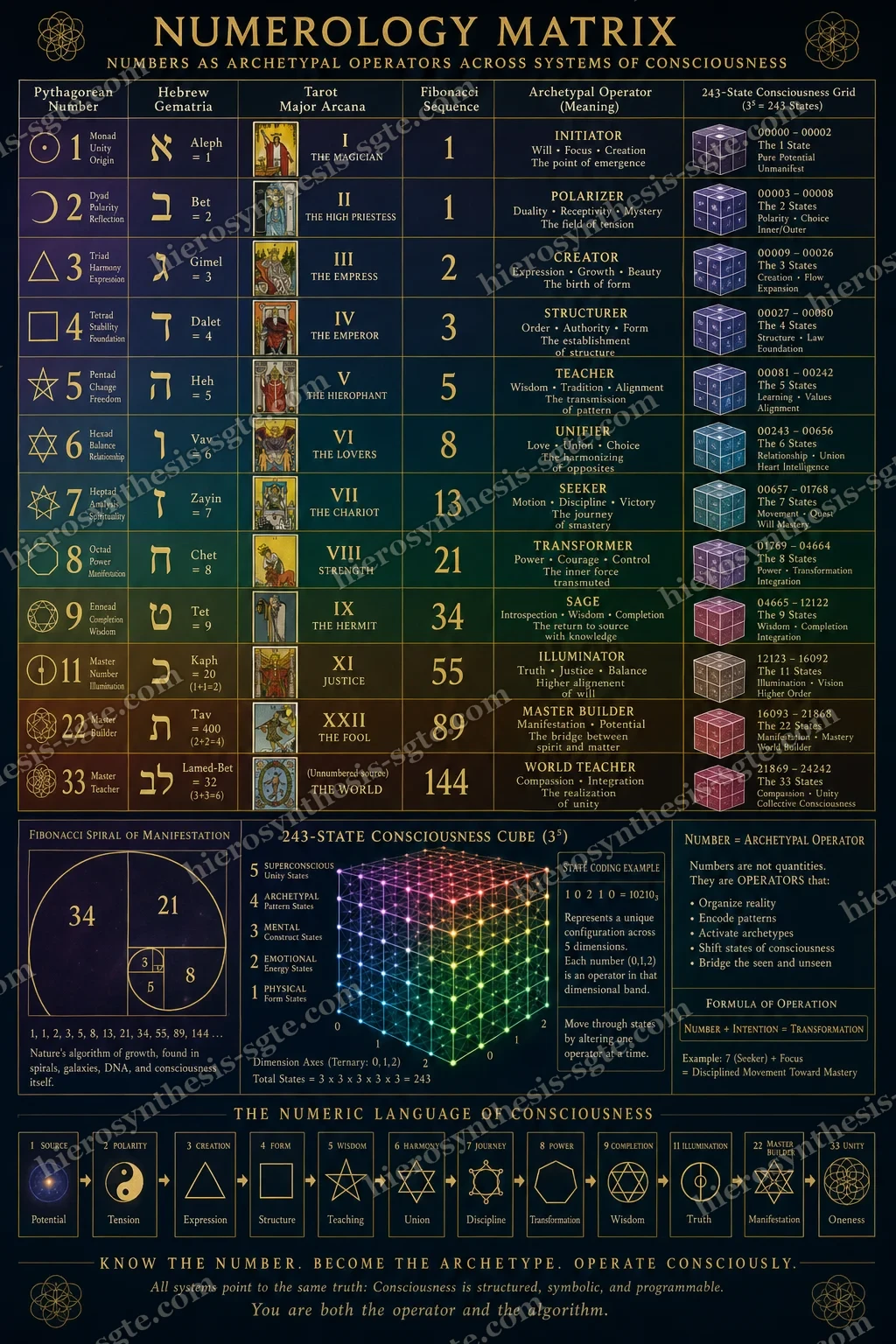
A name calculator. It converts each letter twice — to a Western numerology digit and to a Hebrew letter with its own value — then produces four figures: Expression, Soul Urge, Personality and a gematria total.
What it computes
- 01Strip the name to letters only: spaces, punctuation and accents are dropped, and case is ignored.
- 02Give each letter its Pythagorean value on the A=1…I=9 wheel, restarting at J.
- 03Add all of them and reduce to one digit — except 11, 22 and 33, which are left standing. That is the Expression.
- 04Do the same for vowels alone (Soul Urge) and consonants alone (Personality). A, E, I, O, U and Y count as vowels.
- 05Separately, swap each letter for a Hebrew one and add its Hebrew value — Aleph 1 through Tav 400. That total is the gematria, and it is not reduced.
How to read it
Read Expression as the public shape, Soul Urge as the private want, Personality as the first impression. They are three cuts of the same name, so when two of them land on the same digit that digit is doing most of the work. The gematria total is a different kind of object: it is not a character, it is an address — a number to look for elsewhere in the corpus.
What it does not claim
Two honest limits sit inside the method. The English-to-Hebrew mapping is lossy: A and U both become Aleph, B and V both become Bet, F and W both become Vav, so two different names can produce the same Hebrew string and the same gematria — and two Hebrew letters, Ayin and Qoph, are never produced at all. Traditional gematria works on a name actually written in Hebrew, which is not what this is. And Y is always counted as a vowel here, where most numerologists count it only when it sounds like one, so a name with a consonant Y will differ from other calculators. Beyond the arithmetic: nothing about a name has been shown to predict anything about a person. Read this as a lens, not a measurement.
What do the words on this page actually mean?
Six terms carry the whole calculation.
reading meaning in numbers. Here: turning letters into digits, adding them up, and treating the total as a character description.
the standard Western letter-to-number wheel — A=1, B=2 … I=9, then round again: J=1, K=2, and so on. It is a modern convention named after Pythagoras, not something he wrote.
adding a number's digits together until one digit is left. 47 → 4+7 = 11 → 1+1 = 2. It is how a long total becomes one of nine characters.
11, 22 and 33 are left alone rather than reduced to 2, 4 and 6. Doubled digits are read as carrying extra intensity, so the reduction stops there.
the older Hebrew practice of reading words as numbers. Every Hebrew letter has a value — Aleph 1, Bet 2, up to Tav 400 — so any word has a total, and words sharing a total are treated as linked.
A, E, I, O, U — and on this page always Y — count as vowels. Everything else is a consonant. The split is what separates Soul Urge from Personality.
Where does reading names as numbers come from?
The Hebrew half of this page rests on a plain historical fact: for much of its history the Hebrew alphabet had no separate digit symbols. The letters were the numbers — Aleph 1 through Tav 400 — and they appear used that way on Judean coins from around the second century BCE. When every written word is unavoidably also a sum, readers start to notice the sums, and the interpretive habit called grew out of exactly that. The rabbis of the Talmudic era used it as one tool among many for drawing connections between words of scripture. The most familiar living example is the word chai, “life”: Chet (8) plus Yod (10) makes 18, which is why giving gifts in multiples of 18 is a Jewish custom to this day.
The Greeks kept the identical practice under the name isopsephy — a wall in Pompeii still carries a lover’s boast about “her whose number is 545.” And many scholars read the famous 666 of the Book of Revelation as this same game: “Nero Caesar,” spelled in Hebrew letters, adds to 666. Number-hidden-in-name was simply how the ancient Mediterranean world wrote, so it became one of the ways it read.
The Western half is far younger than its name suggests. Pythagoras, in the sixth century BCE, really did teach that number is the deep structure of the cosmos — but he left no writings and no letter chart. The A=1 through I=9 wheel used here, called in his honor, comes from the American New Thought movement around 1900: Mrs. L. Dow Balliett of Atlantic City published the letter-to-number-to-character system, and her student Julia Seton popularized the very word “numerology.” The vocabulary of Expression, Soul Urge and Personality numbers — and the habit of sparing the from reduction — comes from that modern school, not from antiquity.
So the two wheels on this page are genuinely different objects: traditional gematria is a way of reading a sacred text in its own alphabet, while the modern wheel is a character-reading method barely a century old. What they share is the move itself — paying close attention to a name by way of its numbers. Both are interpretation, not measurement; the arithmetic is shown openly above so you can weigh the readings for yourself.
Go further