◈ Numerology Lab
Full Pythagorean and Chaldean numerology — Life Path, Expression, Soul Urge, Personality, Maturity, and your live Personal Year / Month / Day cycles. Master numbers (11, 22, 33) are preserved in the numbers you are born with — Life Path, Expression, Soul Urge, Personality, Maturity, Birthday — and flattened to 2, 4 and 6 in the three moving cycles, which is the other standard convention and the one this page follows. Computed in your browser, never sent anywhere; your details are saved in this browser only, and the Forget my details button on the Begin page erases them.
In plain words: numerology turns your name and birth date into a handful of single digits and reads each one as a character note. Pythagorean and Chaldean are two different ways of giving letters their numbers. To reduce a number is to add its digits until one is left (2026 → 10 → 1); master numbers 11, 22 and 33 are the exception and stay whole — in the numbers you are born with. In the cycles further down this page — Personal Year, Personal Month, Personal Day — this page follows the other common convention and flattens them to 2, 4 and 6. The paid calendar pages hold them whole instead, so your Personal Day can read differently there; the panel below says exactly when and why.
Three pages here are about your numbers. You are on The Numerology Engine — free · type anything. Open this to tell the three apart, and to see the one place where they honestly disagree. ›
The free calculator. Type any name and any birth date — yours, a friend's, a character's — and read Life Path, Expression, Soul Urge, Personality and Maturity, in both the Pythagorean and the older Chaldean letter tables.
Master numbers: flattens 11 / 22 / 33 to 2 / 4 / 6 in your Personal Year, Month and Day
Every number you personally carry, each explained where it appears, with the letter tally, the karmic lessons, and the full Life Transit Chart across an entire life. One printable sheet to keep.
Master numbers: keeps 11 / 22 / 33 whole
Twelve month-grids from this month, every day carrying its date and your personal day number — with a practice mode that leaves the numbers blank so you compute them yourself. Built to be printed and written on.
Master numbers: keeps 11 / 22 / 33 whole, and marks them in gold
Numerology has two standard habits about the numbers 11, 22 and 33. One tradition holds them whole wherever they appear, because a doubled digit is read as carrying extra intensity. The other flattens them to 2, 4 and 6 in the cycles — Personal Year, Month and Day — and keeps them whole only in the numbers you are born with. Both are in print. Both are defensible. This site runs both: the free calculator flattens, the two paid pages hold.
That is not nothing. Checked across every combination of birth date and calendar day in 2026, the two produce a different Personal Day about one time in ten — the first case is 7 January 2026 for someone born on 1 January, where the calendar reads 11 and the calculator reads 2. The Daily Angel Gate takes a third, shorter road again.
Neither engine has been changed to match the other, because the choice between them is a ruling about the tradition and not a bug to be patched. Until that ruling is made, the honest thing is to tell you it exists. If your two numbers differ, this is why — and the 11 is the one that says “this day was worth circling.”
Start free: the calculator needs nothing from you, and your free reading already includes your current month of numbers. Save your details once at Begin and every page here fills itself in.
Numerology assigns a number to every letter, adds them up, and reduces the total to a single digit. This page runs the two systems that actually differ from one another — Pythagorean and Chaldean — side by side, so you can see where they agree and where they don’t. Everything is computed in your browser and never sent anywhere; your details are saved in this browser only, until you use the Forget button on the Begin page.
What it computes
- 01Pythagorean assigns 1–9 cycling straight through the alphabet: A=1, B=2 … I=9, then J restarts at 1, and so on to Z=8.
- 02Chaldean uses only 1–8 and groups letters by sound rather than order (A, I, J, Q, Y all = 1). Nine is left unassigned, treated as sacred. The two systems therefore give different numbers for the same name — that is expected, not a bug.
- 03Expression sums every letter of the full name. Soul Urge sums only the vowels (A, E, I, O, U). Personality sums only the consonants.
- 04Life Path reduces the month, the day, and the year separately, then adds those three and reduces again.
- 05Maturity adds Life Path to Expression and reduces.
- 06To “reduce” a number, add its digits together and repeat until a single digit remains — except 11, 22 and 33, which are kept whole as master numbers. The Personal Year / Month / Day cycles are the deliberate exception: those reduce all the way to 1–9 by convention.
How to read it
Life Path is read as the arc of the life, Expression as how you operate, Soul Urge as what you want, Personality as what others meet first. Where Pythagorean and Chaldean disagree, the disagreement itself is the information: it usually means the name’s sound and its spelling point in different directions.
What it does not claim
Two choices here change the answer and neither has a single correct setting. First, the Life Path method: this page reduces month, day and year separately before summing. The other common method sums every digit of the date first and reduces once — the two can return different numbers, and practitioners genuinely disagree about which is right. Second, which name you enter: birth certificate, married name, or the name you actually go by will each give a different Expression, and the tradition offers no test to settle which is yours. Also note Y is treated here strictly as a consonant, though some systems count it as a vowel in names like “Lynn”. Run it both ways if it matters to you.
The third system — and why this site leans on it
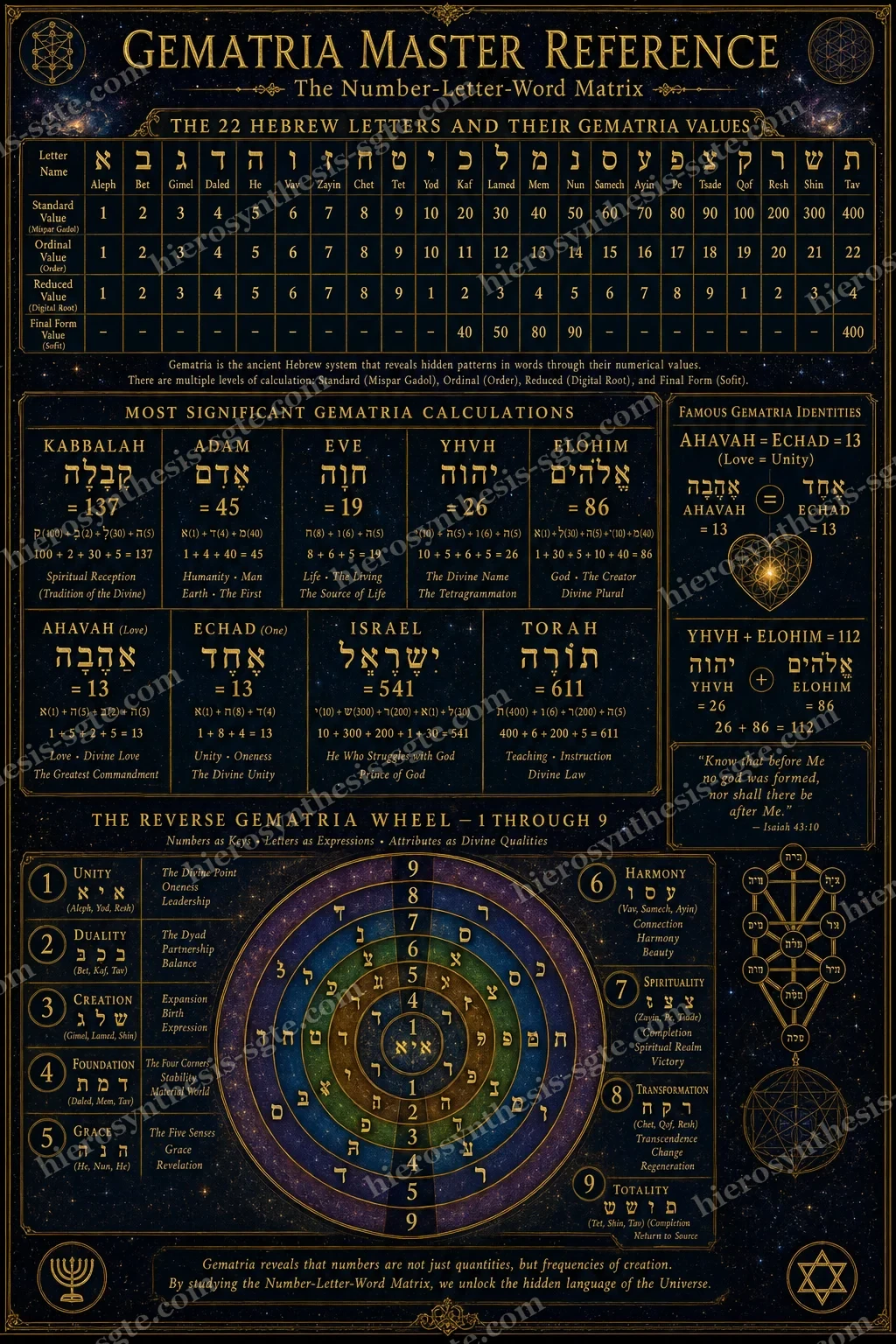
Pythagorean and Chaldean both assign numbers to Latin letters after the fact. Hebrew doesn’t need to: its letters are its numerals, so the values aren’t an overlay on the alphabet, they’re the alphabet itself. That is why the rest of this site computes in Hebrew rather than in either Latin system — and why the 22 letters carry a gematria value natively. The primer below is the same one used by the Name Engine.
Gematria — what it is, and how to do it yourself
Hebrew has no separate digits. The same twenty-two letters serve as the number system, so every letter carries a fixed numeric value: aleph is 1, bet is 2, and so on — 1 through 9, then 10, 20, 30 up to 100, then 200, 300, 400. Gematria is simply adding those values up. A word’s gematria is the sum of its letters. Nothing more mysterious than that; the interpretive move comes afterwards, when two words sharing a sum are treated as related.
Do it by hand: write the word out, look each letter up in the table below, add the values, then reduce — keep summing the digits until one remains (316 becomes 3+1+6 = 10, then 1+0 = 1). That single-digit root is what the readings key on. Elsewhere in this system 11, 22 and 33 are held as master numbers and left unreduced; here the reduction runs all the way down, so a name summing to 11 reports as 2.
The full value table · all 22 letters
Your numbers
Type your name and birth date. Everything is worked out on your own device and never sent anywhere. What you type is saved in this browser only — so every instrument on the site agrees with you and you only type it once — until the Forget my details button on the Begin page erases it.
Pythagorean: A=1 … I=9, then J starts again at 1. The common modern system; master numbers 11, 22, 33 are kept whole.
You will get five core numbers (Life Path, Expression, Soul Urge, Personality, Maturity), today’s cycle numbers, and the arithmetic behind each one so you can check it by hand.
Go further